


By K.V. Chandramouli, Deputy Director of Boilers (Retd.)
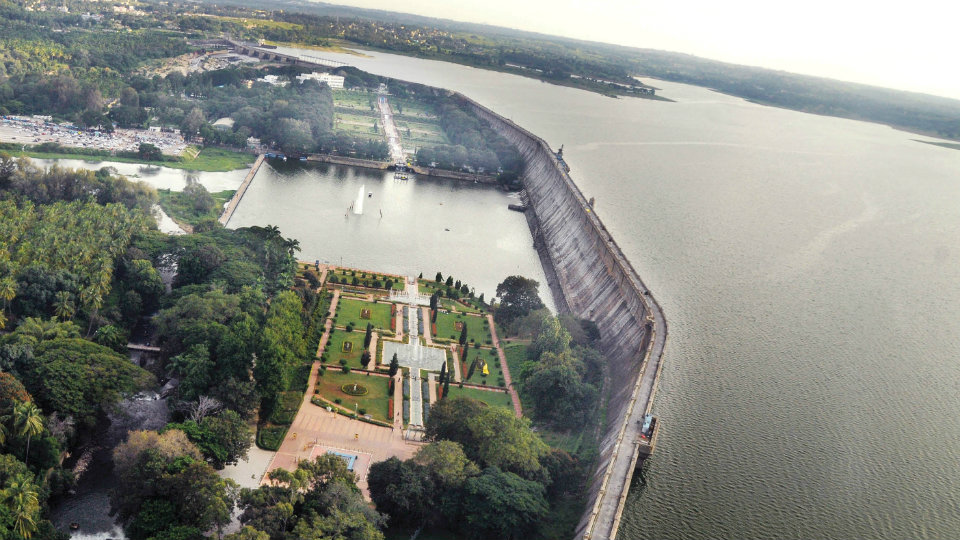
The Karnataka Government plans to organise a Cauvery Aarti at the Krishna Raja Sagar (KRS) Dam, a ritual modelled after the Ganga Aarti, by the time Dasara-2025 arrives. For this initiative, Rs. 92.30 crore has been allocated, and facilities are being developed to accommodate approximately 10,000 attendees.
In addition, it is considering the construction of an Amusement Park, which poses potential risks to the Dam. The allocated funds are designated for creating infrastructure to support large public gatherings, including a stadium, parking areas and various other amenities.
The State Government claims that the event is intended to:
- Raise awareness about the importance of Cauvery River and the need for water conservation.
- Provide a platform to celebrate the cultural and religious significance of Cauvery River, revered as a Goddess in various parts of South India.
However, the proposed Cauvery Aarti faces opposition from numerous individuals and organisations due to its religious implications and expense.
These groups argue that the established practice of offering ‘Bagina’ when KRS Dam reaches full capacity, alongside Theerthodbhava rituals conducted at Talacauvery in Kodagu district, sufficiently expresses devotion to the River.
Critics perceive the Aarti event as indicative of Congress Government’s increasingly accommodating stance towards Hindutva politics.
Dy.CM D.K. Shivakumar has strongly supported the Cauvery Aarti, with plans to establish a permanent ritual along the riverbanks, similar to the Ganga Aarti tradition in Uttar Pradesh. During a visit to KRS Dam, he highlighted Brindavan Gardens as a suitable site for the ritual and directed officials to proceed with its execution. A group of legislators from Mandya, Mysuru and Kodagu, accompanied by officials, travelled to Varanasi and Haridwar to observe the Ganga Aarti.
They studied the ceremony’s rituals and later provided a comprehensive report on how to replicate the event along the Cauvery River. Furthermore, the Congress Government held a symbolic Cauvery Aarti during last year’s Dasara celebrations in Srirangapatna.
The Cauvery Aarti has faced backlash for intertwining religion with politics. A thorough analysis of this initiative reveals that the disadvantages, such as waste generation and carbon emissions, significantly surpass any potential benefits.
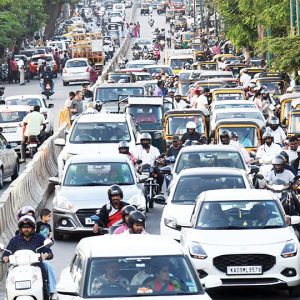
The event is expected to attract a large crowd. With attendance estimates ranging from 20,000 to 25,000 individuals and around 4,000 to 5,000 vehicles, the event may result in considerable waste production, which could threaten local water bodies and the environment.
The influx of vehicles, particularly those that run on fossil fuels, can lead to atmospheric pollution, releasing a mix of harmful substances, including carbon monoxide (CO), nitrogen oxides (NOₓ), volatile organic compounds (VOCs), particulate matter (PM) and carbon dioxide (CO2).
The convergence of both vehicles and people at this event will inevitably leave a substantial carbon footprint. India has committed to achieving net-zero emissions by 2070 at the COP26 Summit in Glasgow in 2021. Cauvery River is essential for farmers’ livelihoods and the daily routines of millions in Bengaluru. It provides vital irrigation water that sustains regional agriculture and is also a key source of drinking water.
Therefore, the Government should prioritise efforts to rejuvenate Cauvery River — an indispensable lifeline for millions in South India — rather than spending on Aarti. The Government should prioritise investing in the following initiatives aimed at addressing the challenges to restore the river’s ecological health and ensure its sustainable future, rather than directing taxpayer funds toward the Aarti.
Focus on afforestation
The total length of the Cauvery River from the origin to its outfall into the sea is 800 kms of which 320 kms is in Karnataka, 416 kms in Tamil Nadu and 64 kms in Kerala and Puducherry.
The inflow of water in Karnataka relies significantly on the Southwest Monsoon, which delivers substantial rainfall to the Western Ghats and serves as a major water source for Cauvery basin. The level of rainfall in the Basin’s catchment areas, including Kodagu and Chikkamagalur, directly affects the volume of water that enters the river and its reservoirs. While the connection between rainfall intensity and forest cover is not strictly linear, forests are essential in influencing local rainfall patterns and water cycles.
Forests release water vapour into atmosphere through evapotranspiration, which can contribute to local rainfall. Studies have shown that forests in Western Ghats, which form part of Cauvery basin’s catchment area, can contribute significantly to rainfall in the region and even in water-deficient areas like TN.
Forests can recycle moisture locally, meaning water that evaporates from the forest can be returned as rain in the same area, contributing to a more consistent rainfall pattern. Forests can influence cloud formation by releasing aerosols and influencing temperature and humidity. Deforestation can disrupt these processes, potentially leading to reduced rainfall and increased rainfall variability.
Studies have shown that deforestation can reduce rainfall in tropical rainforests, known to generate rain. Cauvery basin is experiencing changes in land use, including deforestation, which can affect the intensity and distribution of rainfall.
As a result, the connection between forests and rainfall is complex and influenced by several factors; however, the forests in the catchment areas of Cauvery basin do impact rainfall intensity.
To increase water inflow, the primary strategy should involve boosting rainfall and effectively managing water resources. This can be accomplished through afforestation and rainwater harvesting, which not only enhance rainfall but also reduce soil erosion, improve water infiltration and groundwater recharge.
Motivating judicious water use
As the Cauvery basin brims over, Bengaluru can breathe. The city requires around 2,632 million litres of fresh water daily (MLD). Now, Bengaluru gets 1,450 MLD from Cauvery River, with plans to increase this supply by an additional 775 MLD on completion of Cauvery V Stage.
Groundwater sources provide an estimated 1,372 MLD, but the extraction rate is unsustainable due to lower natural replenishment rate. To tackle water-related challenges in Bengaluru and secure a sustainable water supply, careful management of Cauvery water is essential.
Therefore, the Government should:
- Encourage residents to adopt water-saving habits in their daily lives, such as fixing leaks, using water-efficient appliances and practising water-conserving gardening techniques.
- Conduct regular water audits for both households and businesses to pinpoint areas of high water use.
- Introduce pricing incentives to reward careful usage and impose penalties for excessive consumption.
- Launch campaigns to inform citizens about significance of water conservation and the repercussions of waste.
- Enhance efficiency of water distribution networks to ensure fair and timely access to water throughout the city.
- Support initiatives aimed at recharging groundwater through rainwater harvesting and other techniques to enhance the city’s water supply.
- Increase use of treated wastewater for non-potable applications — gardening, landscaping, industrial cooling.
- Establish regulations for borewell usage and encourage transition to Cauvery water connections in regions with declining groundwater levels.
Encourage farmers to adopt efficient water management techniques
The agricultural sector, which represents a significant share of water usage, continues to largely depend on flood irrigation — an approach noted for its inefficiency. In Karnataka, 1 tmcft (Thousand Million Cubic Feet) of Cauvery water can irrigate around 10,000 to 12,000 acres, whereas in TN, the same amount irrigates about 40,000 to 50,000 acres.
These figures may fluctuate due to various factors such as crop type, soil conditions and irrigation techniques. To enhance irrigation systems and promote sustainable food production, effective water management is crucial. By adopting efficient water management strategies, we can optimise water use, minimise waste and improve crop yields.
More sensible options
Rejuvenating Cauvery River through tree planting, enhanced water management and regulating carbon footprint is a more effective and sustainable method than merely hosting Cauvery Aarti event. Although the Aarti holds cultural and spiritual importance, prioritising practical measures to restore the river’s flow and well-being will produce a significant and enduring positive effect on both the environment and communities that rely on it. Given the Government’s decision to proceed with Cauvery Aarti without thoroughly evaluating its wider consequences, it would be prudent to abandon this initiative. Instead, Government should redirect its efforts towards implementing strategies to restore and revitalise Cauvery.


Recent Comments