



Just a week after we celebrated Children’s Day, we were confronted with a brutal truth: Our children are not safe in the schools meant to nurture them.
In Delhi, a 16-year-old boy died by suicide after relentless harassment by his teachers.
In Mumbai, a 13-year-old girl collapsed and died after her teacher forced her to do 100 sit-ups with her schoolbag on as punishment.
And in Palghar, a group of terrified students fled into the jungle! Yes, into the jungle after being beaten for not fetching water on time.
What does it say about us as a society when children find wilderness safer than their classrooms?
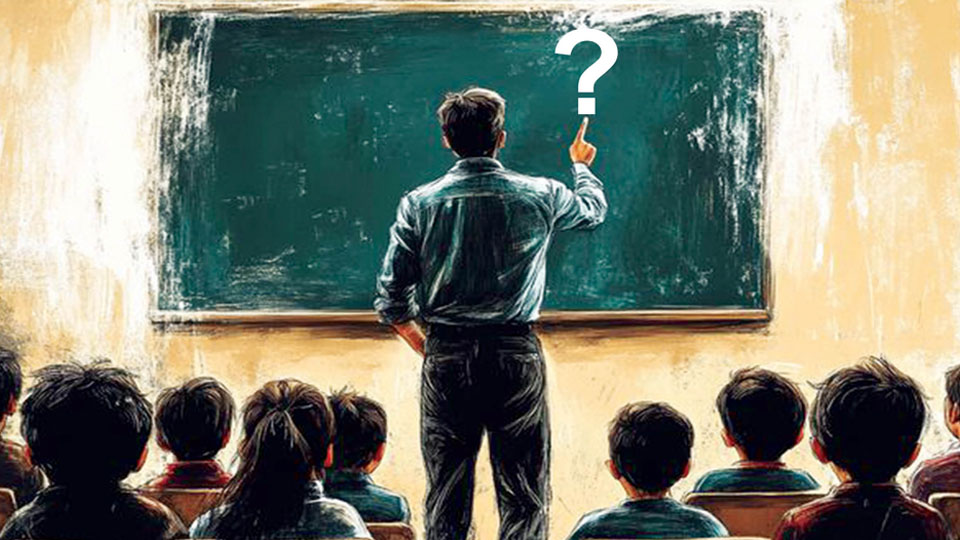
If anything is clear, it is this: The time has come to educate the educators. Not in the subjects they teach, but in how they treat the children in their care.
In the age of Artificial Intelligence (AI), emotional intelligence of teachers matters more than ever.
Today, schools are no longer the ‘temples of knowledge’ they once were and teachers are no longer the high priests. Children have information on their fingertips. They swipe, tap and click their way through the digital oceans of knowledge.
Teachers cannot merely be informers anymore. Their value cannot lie solely in delivering content because technology already does that, often better and faster.
Instead, teachers must evolve into mentors, guides and emotional anchors.
AI may lighten their academic workload, but it cannot provide what children desperately need: A human being who sees them, hears them and understands them.
But teaching with empathy is easier said than done.
Today, a teacher’s success is often measured only by a child’s marks, rankings, exam results and homework completion. Under this relentless performance pressure, teachers become harsh, anxious and punitive.
Their frustration gets directed towards students who do not grasp a concept immediately or who appear distracted. This transforms the teacher from a figure of trust into an object of fear. And fear is the most corrosive thing in a classroom.
Of course, it is difficult to remain calm and compassionate when a room full of restless children test your patience. But difficulty cannot be an excuse to turn into a fearful, authoritarian figure.
For many students, teachers are counsellors, therapists and support systems rolled into one. Children today navigate exhausting worlds. One world, which is real and filled with academic pressure; then another, a digital world filled with comparison, anxiety and overstimulation.
Children need a teacher who brings what Google, YouTube & ChatGPT cannot: Kindness.
A teacher can be stern and sternness is often necessary. But the sternness must be fair and sprinkled with kindness.
Kindness does not weaken discipline instead it strengthens
trust. When children trust their teachers, they study better, behave better and grow better.
I remember a teacher of mine who would always say, “There are no stupid questions.” But every time someone asked something that sounded silly, she would smile gently, pause and say, “The answer is, of course, obvious…” and then proceed to explain it patiently.
It was her way of preserving curiosity while saving the child from embarrassment. That single moment of grace can shape a child’s entire confidence.
Another memory stays with me. In Saraswathipuram lived an elderly teacher, G.T. Narayana Rao (GTN).
One day, I walked past him while he was chatting with our neighbourhood Maths teacher. I stopped to greet them.
The Maths teacher looked at me and sneered, “Good morning, Jack,” then told GTN with a laugh, “He’s a jack of all and master of none.” He said this because I had taken up and dropped several hobbies such as music, tabla and sketching.
I let out an embarrassed grin. GTN noticed. He turned to the Maths teacher and replied calmly, “Meshtre, you should know he may be a jack of all and master of none, but in life that is often better than being master of one.”
In that moment, GTN protected not just me but the idea that children have self-worth. He knew that a careless remark could wound a child for years. With one gentle sentence, he restored my confidence and taught a seasoned teacher a lesson in both kindness and knowledge.
The truth is simple. Students rarely remember teachers for their scholarly brilliance. But they remember the ones who made them feel safe.
They remember the ones who removed fear from the classroom because only then can the mind truly “hold its head high,” as Tagore wrote.
Fear kills curiosity and curiosity is the root of excellence, innovation and enlightenment.
A classroom built on fear produces only obedience and silence, a herd of sheep rather than a generation of thinkers.
This is why corporal punishment must not simply be discouraged but eliminated. Not on paper, not as a symbolic annual reminder, but in real, enforceable practice.
For India to become a humane and enlightened society, our schools must change. For our schools to change, our teacher training must change.
Empathy and compassion cannot be optional modules; they must be the core of teacher education. Until then, we will continue to fail our children.
The future of our society depends not on how well our children score, but on how kindly they are raised. Only empathetic educators can raise empathetic citizens and we need it desperately in these toxic and polarising times.
e-mail: [email protected]



Recent Comments