


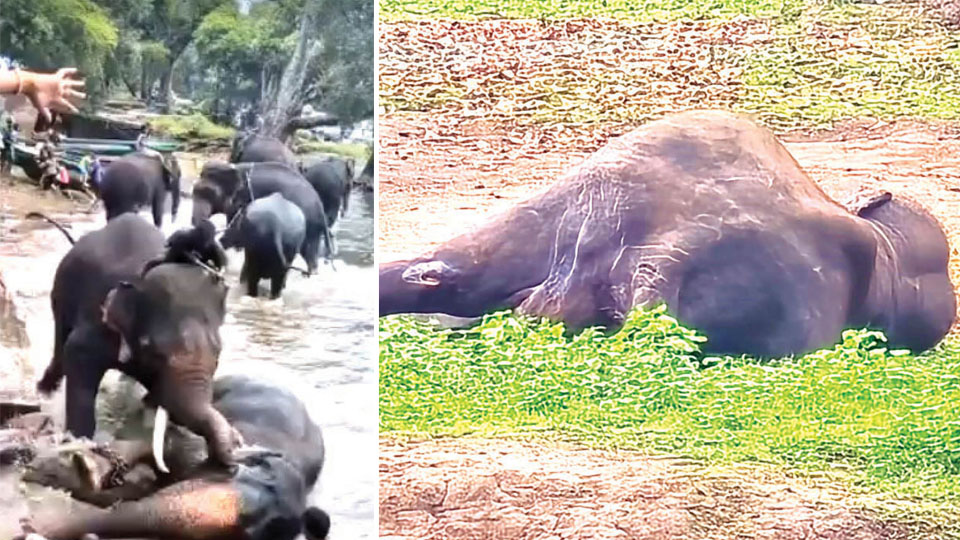
Camp houses 30 elephants against capacity of 22; 60 staff manage jumbos, 1,000 tourists
Kushalnagar: A day after being attacked by Dasara elephant Kanjan at the Dubare Elephant Camp, elephant Jai Marthanda (34) succumbed to his injuries this morning.
Jai Marthanda had suffered grievous injuries during the violent clash and reportedly lost a large amount of blood into the River Cauvery after Kanjan repeatedly gored him.
Sources at the camp said Jai Marthanda was unable to effectively defend himself as he did not have tusks. During the attack, he lost balance in the water after being pushed by Kanjan, which continued to gore and pin him down with its full weight.
Though the injured elephant managed to regain balance and run to safety, Kanjan chased and attacked him again.
Soon after the incident, veterinarian Dr. Mujeeb rushed to the camp and began treatment. Caretakers said Jai Marthanda remained in critical condition through the night and had refused to consume food after the attack.
“Normally, turmeric is applied for minor wounds to prevent infection. But the doctor advised against native treatment as the injuries were very deep and there was a high risk of pus formation. Three injections were administered, but recovery was slow. Today, we lost him,” an elephant caretaker told Star of Mysore.
Overcrowding, staff shortage
Sources said that the Dubare camp is functioning beyond its recommended capacity. While the camp is meant to house around 22 elephants, it currently has 30 elephants, including reportedly aggressive ones such as Sugreeva, Dhananjaya and Prashantha.
Handlers and wildlife experts are now demanding that aggressive elephants be shifted away from tourist interaction zones, leaving only calm and well-trained elephants in public areas.
Crowd Management
Officials are also examining crowd management issues at the camp. On peak days, more than 1,000 tourists reportedly visit the camp at the same time, alongside rafting crowds, while several elephants are taken to the river for bathing.
Sources said the absence of regulated visitor slots leads to heavy crowding between 9 am and noon, causing disturbance to the elephants and affecting the river water conditions.
The camp currently operates with around 60 staff members, including Forest Department personnel, mahouts and kavadis. “Managing 30 elephants and over 1,000 tourists with such limited manpower is extremely difficult,” a source said.
Concerns have also been raised over the declining role of senior mahouts, with younger and relatively inexperienced kavadis increasingly handling direct interaction with the elephants.


Recent Comments