


By Dr. R. Balasubramaniam
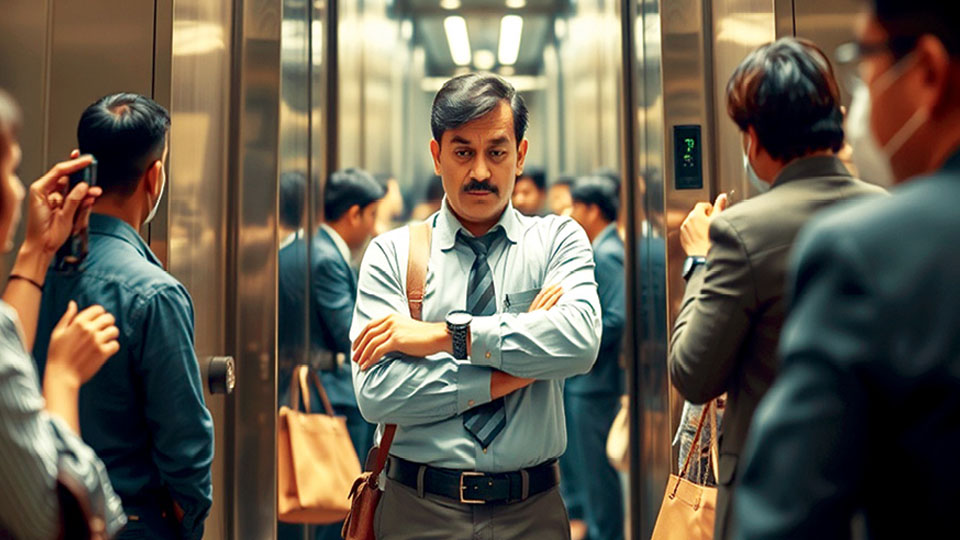
If patience is truly a virtue, then every employee in my office building — the venerable STC building (officially known as the Jawahar Vyapar Bhavan) on Janpath, New Delhi — should be eligible for sainthood. It is not because we have suddenly become paragons of meditation and self-restraint. It is due to the interminable, soul-testing, career-shortening wait for the elevator.
Now, before you assume I am just being dramatic, let me paint a picture. You step into the building, refreshed and enthusiastic (or as enthusiastic as one can be before the first coffee of the day). You press the button for the lift. You wait. You check your phone. You look around aimlessly. You check your phone again. You sigh audibly. Five minutes have passed, and there is no sign of movement. You begin contemplating whether it is faster to age gracefully on the ground floor or risk your knees and take the stairs to the twentieth floor where your office is located. Then suddenly — miraculously — the lift arrives!
Just as you are about to step in, an invisible force stops you. A security officer appears out of nowhere, brandishing his arm like a traffic cop at peak Connaught Place congestion.
“Sorry, sir. Special lift movement.”
And just like that, the doors slide shut in your face. The lift is now exclusively reserved for one of our esteemed, ‘special’ elites. It ascends serenely, carrying its VIP occupant to their lofty destination. The journey is without the common folk cluttering their airspace.
Meanwhile, we mere mortals stay glued to the floor. We wonder if our careers will end before we even reach our desks.
The curious case of the ‘special’ lift riders
Now, I have nothing against VIPs. The government thrives on hierarchy, and some amount of protocol is understandable. But when a public lift starts functioning more like a private limousine, we have a problem. And trying to stick to my ‘commoner’ roots despite being eligible for these ‘special’ privileges left me wondering whether I can truly live my own convictions. More about my own confused convictions later.
Why is it that certain people — based on an invisible algorithm more complex than the one used by the Income Tax Department — are granted solo lift privileges? What happens in those moments of solitary ascension? Do they have secret policy meetings? Do they get a five-minute nap? Are they communing with the lift gods for some special blessings? We, the people left stranded below, can only speculate.
The three stages of the elevator waiting game
As someone who has spent a considerable part of my last four years of government work life standing next to an unco-operative elevator, I have observed that the wait follows a predictable pattern:
1. Hopeful optimism: You press the button, believing that today will be different. The lift will come swiftly, and you will glide up without delay. You even smile at your colleagues.
2. Mild despair: Five minutes pass. You start fidgeting. Your courage of conviction is beginning to weaken. Temptation of privilege starts setting in.
3. Resignation to fate: A senior official enters the building. The security personnel spring into action, and you already know what is coming. You sigh, step back, and accept your destiny — your place in the pecking order cemented as firmly as the building’s foundation. But at least your conscience is still untainted.
4. Joining the elites: You now realise that staying rooted in your beliefs is costing you time. It is also costing you efficiency. You convince yourself that it is better to be a part of the ‘elites.’ You start hoping that someday, this building will have more lifts functional than dysfunctional. (Only two out of the five lifts work, and we have been given the hope raising promise that the lifts will be repaired soon. Only that this promise is now years old, and my term will end sooner than the lifts being repaired.) You succumb to becoming a part of the elite and give yourself the justification of how important you too are to the system and the need to deploy your time to something more worthwhile.
A modest proposal: Equality in elevation
If democracy means anything at all, should it not extend to basic vertical mobility? Shouldn’t we all, regardless of rank, share the same box of moving metal? Perhaps, in an ideal world, all lifts would follow the principle of first come, first served, rather than first rank, first ride.
Until that utopia arrives, I have devised a few coping strategies:
The “sprint and sneak” method: If you see an approaching VIP, make a run for it. Once inside, keep a strategic position at the back, avoiding eye contact and pretending to check e-mails. With luck, they won’t evict you. If they politely ask you to, pull rank and let them know you are part of their privileged club too.
The “elevator camaraderie” hack: If enough people band together in collective resistance, we can create an Occupy Elevator movement. There is strength in numbers, and my activist past does sometime catch up with my current life. (Unless, of course, the lift has a weight limit.)
The staircase solution: While not ideal (or kind to one’s knees), climbing twenty flights of stairs does wonders for fitness. You will arrive sweaty, but at least you will arrive. However, I have yet to try this strategy. Compromising seemed less arduous than walking up for the next thirty minutes.
Final thoughts from the lobby of the STC building
I may joke about it, but the lift situation in our office is intriguing. It reflects a larger truth — the delicate balance between privilege and equality. It reminds us that in every institution, some individuals are destined to ascend effortlessly. Others must press the button and wait. And wait. And wait.
But who knows? Maybe one day, an enlightened policy change will guarantee that we all ride the lift together, in perfect bureaucratic harmony. And isn’t that something a part of my JD to deliver?
Until then, if you need me, I will be the guy standing next to the lift. I will be waiting and sighing. I will also be reconsidering my life choices.
[Dr. R. Balasubramaniam is the Founder of Swami Vivekananda Youth Movement. ‘The Lighter Side’ is a series of satirical articles meant to bring a smile by highlighting the funny side of everyday life.]



Recent Comments