


By Dr. K. Javeed Nayeem, MD
Let alone knowing him personally, I never had an occasion even to meet him or hear him speak, although I have read almost everything that he has written, especially by way of his half a dozen books, the best of which according to me is, ‘A walk up the hill’, which I feel, no man, woman or child, interested in our environment, should miss reading.
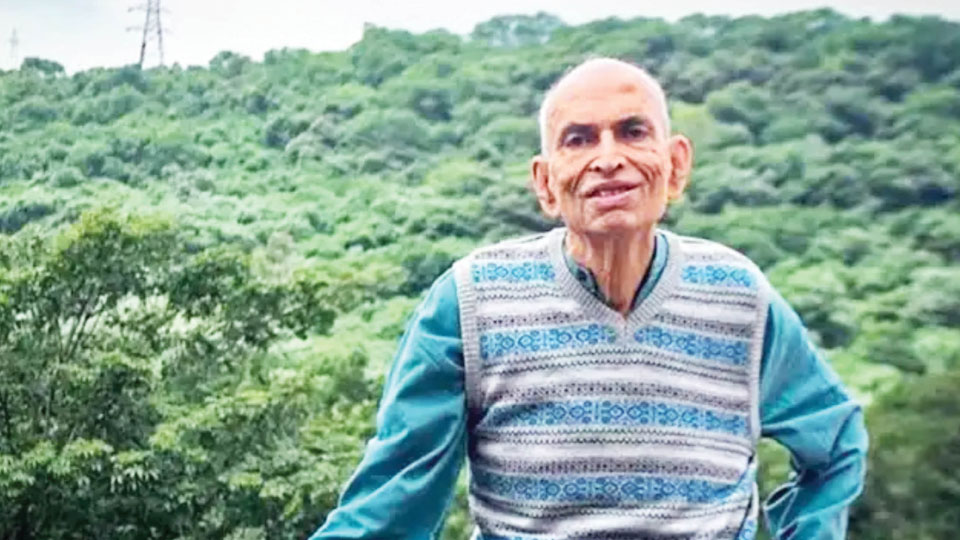
But I’m going to miss this man, Madhav Dhananjaya Gadgil, the little-known man who passed away in Pune, four days ago at the age of 83, for I used to see him as the right kind of medicine-man, for safeguarding the health of our environment in general and our magnificent Western Ghats in particular, which have nourished me and my forefathers, for nearly four full centuries.
My family lore has always told me that they moved over to the farthest reaches of the Ghats that long ago, for some very obscure reasons, open to much discussion, debate and even speculation.
But I have always been and I still remain, rooted to the deepest reaches and the loftiest heights of this most beautiful mountain range that brings rain, resources, sustenance and fair weather to the whole of peninsular India, making it a most wonderful place to live in. Yes, it is their imposing presence that goes to make the verdant and fertile landscape we South Indians live in, remarkably different from the vast yellow-brown and not so fertile lands, our other countrymen inhabit, north of this region.
Gadgil, a Padma Shri and Padma Bhushan awardee, was a scientist with admirable academic qualifications, who was either the head or a member of many high-level committees constituted by the government on different occasions, to address different problems, as they arose. But I do not wish to give an elaborate account here about these aspects of his personality and will therefore restrict myself to pointing out what was unique about him and his way of thinking.
As I know them, most ecologists and environmental activists can in a way, be called extremists, although I do not mean it in the present, most well-known connotation of the word. I use this term only because it best describes their extreme stand in the present ecological scenario. They either support human interests entirely or the interests only of the environment we humans dwell in.
The latter however, greatly outnumber the former, for reasons that are very interesting but are of no relevance to what I am writing here. But they all do tend to forget that these two elements, the people on one side and the environment on the other, just cannot exist as two separate entities, without affecting each other’s lives and rights to existence.
This is where Gadgil was different, because he understood that co-existence was the only way forward and he therefore advocated treading the middle path, with caution, commonsense and concern for both man and beast. He argued that wildlife protection laws (like India’s Wildlife Protection Act, 1972) often prioritise animals over human safety, creating absurd conflicts and called for a shift to more pragmatic, community-led conservation, citing Scandinavian models where regulated culling of predatory animals, manages populations for balance, stressing that human well-being too must get the necessary attention, in addition to species protection, especially in human-wildlife conflict zones.
He asked, “If a human breaks into your home and attacks you, the law allows you to defend yourself, even if it means killing the intruder. Why should citizens lose that right and their lives, when the attacker is a wild animal? This is the contradiction people in conflict zones face every day. Their safety is treated as secondary.”
Criticising what he calls India’s unscientific and ineffective approach to wildlife conflict, in an interview with Hindustan Times, Gadgil explained the rationale behind seeking hunting permissions and emphasised the need to shift power to local communities, advocating a democratic, decentralised, community-led model of wildlife governance.
Citing the rapidly escalating incidents of man-animal conflict involving leopards, wild boars and elephants and people who dwell in the fringes of our forests, Gadgil said he believes the debate over wildlife conflict management has reached an urgent phase. According to him, the Wildlife Protection Act, 1972, effectively places leopards, wild boars, elephants and other species ‘above human lives,’ which he calls ‘completely absurd.’
Scandinavia faced intense conflict with its wolf population. They see wildlife as a renewable commodity. When populations grow beyond the land’s capacity to sustain them, they are culled to maintain balance. Local communities decide how much population can be supported and hunting permissions are issued accordingly.
Sweden, which is swarming with reindeer, follows the same principle. It has worked well for them. Their system is decentralised and pragmatic. They don’t wait for tragedies — they prevent them.”
He goes on to say, “We must accept that culling certain animals is sometimes necessary for overall balance. This is not anti-conservation but, on the contrary, it is responsible conservation. Wildlife cannot be placed above human lives and coexistence does not mean tolerating human deaths and destruction of property. It means creating conditions where both humans and wildlife can thrive. India needs a scientific, humane, community-led conflict management system and the time to reform the old framework is now.”
Renowned Historian Ramachandra Guha, who has co-authored two books with Gadgil, summarises his unique qualities as a deep knowledge of his land and its people; profound intellectual originality; courage to oppose intellectual fashion; the ability to unite intellectual and practical agendas; strong democratic instincts; and an absence of cynicism.
At a time when we are seeing, across many regions of our country, a rapid increase in the incidents of man-animal conflict, very often with the tragic loss of human lives and the abject failure of the authorities in preventing these, with their present strategies, I feel that it is time for us to start taking some hard decisions and actions too, to set right this grim situation. Very unfortunately, most people who are themselves not affected by it, do not understand the vexing consequences of this increasing problem. We must remember that human lives too are precious, just like and just as much as the lives of animals!
e-mail: [email protected]




Recent Comments