


Mysuru researchers offer hope against deadly tissue damage from viper bites, preventing amputations
By S. Kenneth Shishir
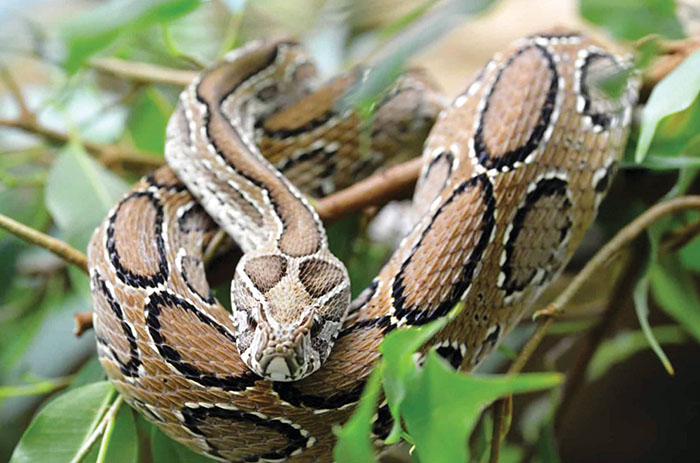
Snakebite continues to claim numerous lives in India, with most cases attributed to four species — the cobra, krait, Russell’s viper and saw-scaled viper, collectively known as the ‘Big Four.’
At present, the only available treatment is Polyvalent Antivenin Therapy, which uses antibodies raised against the venom of these four snakes. However, there is still no effective therapy to treat or prevent the severe tissue damage and skin decay caused particularly by viper bites.
In a significant breakthrough, Prof. K. Kemparaju, Senior Professor at the Department of Studies in Biochemistry, University of Mysore and Prof. Kesturu S. Girish, Professor at the Department of Studies in Biochemistry, Tumkur University, have identified key mechanisms behind venom-induced tissue damage and explored ways to counter it.
Their research offers promising possibilities in addressing one of the most challenging aspects of snakebite treatment and has the potential to save thousands of lives, not only in India but globally.
Star of Mysore spoke to Prof. Kemparaju and his mentee Prof. Girish, who were recently honoured in city with the prestigious Bhramara Award for Research Helping Humanity, instituted by the Bhramara Trust of Y.T. and Madhuri Thathachari, Mysuru. Excerpts:
Star of Mysore (SOM): What are the effects of a viper bite?
Prof. Kemparaju & Prof. Girish: A viper bite causes severe tissue damage at the site of the bite and the extent of this damage varies from person to person. At present, there is no specific medicine or therapy to treat this tissue decay. In many cases, the only option left is amputation.
SOM: Can you briefly explain your research and findings?
Prof. Kemparaju & Prof. Girish: Our research shows that conventional anti-venom often fails to reach the site of tissue damage because of blockages in blood vessels. We then studied how the immune system responds to viper venom, particularly the role of white blood cells.
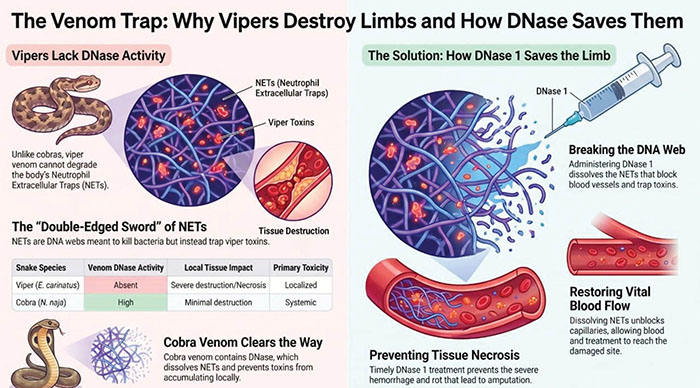
We observed that certain cells, called macrophages, contribute to tissue damage. While studying further, we identified another type of white blood cell known as neutrophils. These cells fight microbes by releasing a web-like structure made of their own DNA, known as Neutrophil Extracellular Traps (NETs).
These NETs trap venom toxins but also block blood vessels and attack tissues at the bite site. As a result, the affected tissues are deprived of oxygen and begin to die. In our experiments on rodents with lower levels of neutrophils, we found that tissue damage was significantly reduced.
SOM: How do NETs function in this context?
Prof. Kemparaju & Prof. Girish: NETs are part of the body’s natural defence system and are known to immobilise and kill pathogens. However, they can also cause collateral damage due to their toxic components.
In the case of a viper bite, NETs trap and concentrate venom toxins at the site of the bite. This accelerates tissue destruction. While these structures are meant to kill harmful microbes, they end up attacking the body’s own tissues, leading to severe local damage, necrosis and what is often described as “skin rot,” which can eventually require amputation.
SOM: How effective is your approach?
Prof. Kemparaju & Prof. Girish: In our experiments on mice, we found that administering Deoxyribonuclease (DNase1) helps break down these DNA webs. This prevents severe tissue damage and reduces the risk of limb loss.
This approach could be a major breakthrough, as it may reduce dependence on high doses of anti-venom and help prevent amputations.
SOM: Does venom potency vary across regions and how effective is anti-venom?
Prof. Kemparaju & Prof. Girish: Yes, venom potency varies from region to region. For instance, the potency of viper venom in Karnataka is different from that in Kerala.
Currently, a universal anti-venom is used across regions. However, there is a growing need to develop region-specific anti-venoms to improve effectiveness.

Recent Comments