


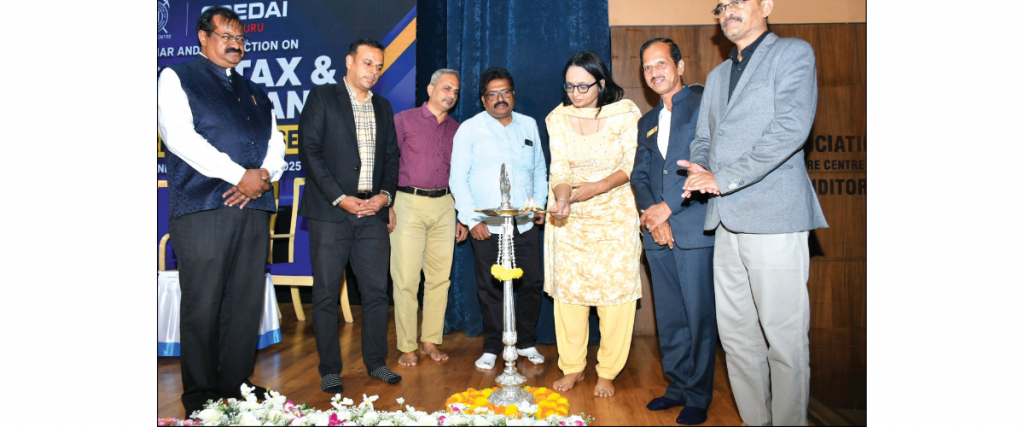
Mysuru: The forthcoming Income Tax Act, 2025, which is set to replace the decades-old Income Tax Act of 1961, has been designed to be simpler, more transparent and more taxpayer-friendly, according to Range-1 Additional Commissioner of Income Tax Kalpalatha Rajan.
Speaking at a seminar on ‘Income Tax and Compliance in the Real Estate Sector under the New Act,’ jointly organised by the Confederation of Real Estate Developers’ Association of India (CREDAI), Mysuru and the Builders Association of India (BAI), Mysuru, at MBCT auditorium in city recently, Kalpalatha Rajan outlined the key reforms proposed under the new legislation.
She said that the 1961 Act had been amended hundreds of times over the decades, often resulting in confusion and avoidable litigation. The new law, she explained, aims to address these concerns by improving tax certainty and enabling easier digital compliance.
Old Act lacked clarity
Kalpalatha Rajan also highlighted that the real estate and construction sector plays a crucial role in India’s infrastructure growth. However, she noted that the sector faces structural challenges, including long gestation periods, complex project cycles of 5-7 years and difficulties in revenue recognition.
“The old Act lacked clarity on these aspects, but the new law addresses them directly,” she said.
Ahead of its rollout, the Income Tax Department has launched a nationwide awareness campaign titled ‘Prarambh-2026.’
Under this initiative, officials are engaging directly with stakeholders across sectors such as manufacturing, services and real estate, moving beyond traditional office-based interactions.
To support taxpayers further, the Department has introduced ‘Kar Setu,’ a comprehensive information guide and ‘Kar Saathi,’ a 24×7 AI-powered chatbot. These digital platforms are intended to provide clarity on tax laws, rules and circulars.
Kalpalatha Rajan emphasised that the awareness programmes are designed to be interactive rather than one-sided.
“We are here not only to explain our policies and expectations but also to listen to the practical challenges faced by industry and take their suggestions on board,” she said, urging open dialogue to resolve existing ambiguities and improve the system.
Later, Circle-1 Assistant Commissioner of Income Tax S. Venkateshan demonstrated the ‘Kar Setu’ and ‘Kar Saathi’ systems for real estate stakeholders.
The event was attended by Income Tax Department officials, including Deputy Commissioner of Income Tax (DCIT) R. Ranganathan, CREDAI Mysuru President M.S. Harish Shenoy, Secretary Nagaraj V. Bairy, BAI Mysuru President Prabhakar Rao and Secretary Praveen Pal.


Recent Comments