


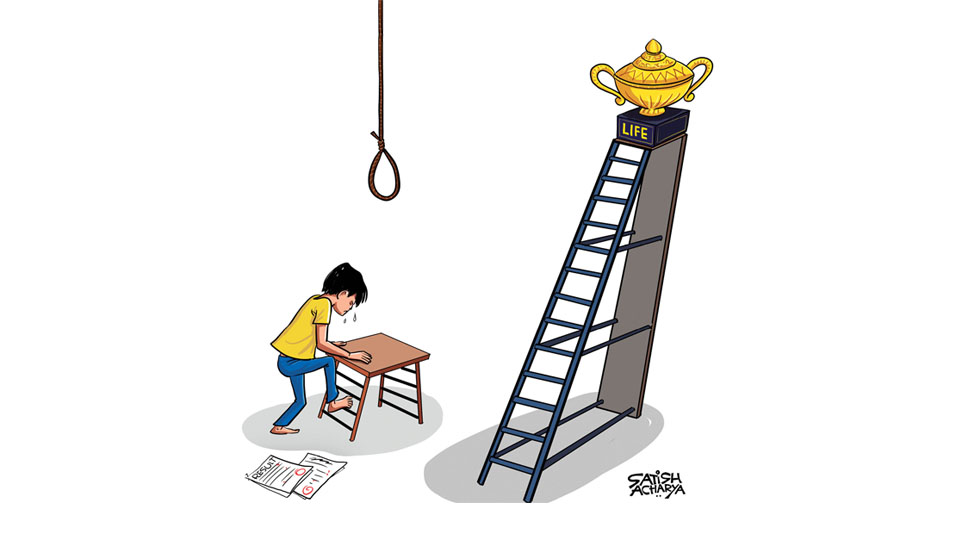

Every year, when SSLC and Pre-University results are announced, the State witnesses a familiar cycle of joy, disappointment, relief and grief. But what should garner our attention is… death.
Last week, five students ended their lives following their results. Three of them did so because they did not secure the marks they had hoped for.
Children, barely 15 or 18, are concluding that life itself is not worth living because of an examination.
According to the National Crime Records Bureau (NCRB), over 13,000 students died by suicide in 2023. Nearly 10,000 of them were below 18. Among the reasons cited, failure in examinations remains a prominent trigger.
The result season in India is no longer an academic checkpoint. It is a social spectacle.
Colleges seek rankings to boost their market value. School principals chase pass percentages to secure their positions. Coaching centres hunt for toppers to fill their advertisements. Parents, often unconsciously, seek validation through their children’s marks.
In today’s climate, even excellence has been devalued. Marks in the 90s, once celebrated, now barely raise eyebrows. Cut-offs hover at 98 percent, and even there, competition is fierce.
We have created a system where achievement is inflated and self-worth is deflated.
In India, failure in SSLC or PUC is not treated as a setback; it is treated as a full stop. At 15 or 18, an exam becomes a verdict.
A poor result is internalised as permanent inadequacy. The idea that one can recover, recalibrate, and rise again is rarely communicated with conviction.
Add to this the steady inflation of qualifications and the pressure increases.
There was a time when a high school certificate ensured a stable livelihood. Then came degrees, which once distinguished individuals. Soon, degrees became commonplace.
Postgraduate qualifications followed the same trajectory. Today, even multiple degrees struggle to guarantee opportunity.
We are pushing children to chase credentials that are steadily losing their currency, while ignoring abilities that may actually matter in the future, such as creativity, adaptability, and entrepreneurial thinking.
Our education system continues to reward conformity over curiosity. It stigmatises talent that does not fit neatly into conventional academic success. We are still judging a fish by its ability to climb trees. But that is set to change.
With Artificial Intelligence reshaping industries and career paths, the future will belong not merely to those who score well but to those who can think independently and innovate.
More importantly, those who are emotionally resilient.
Encouragingly, some institutions like 10X, an offshoot of Indus School in Bengaluru, have begun integrating entrepreneurship and practical learning alongside traditional academics.
But such efforts will remain the exception, not the norm.
At its core, the crisis is not about exams. It is about how we interpret them. The present standards don’t need dilution, just a broadening of perspective.
Emotional intelligence must become as important as academic achievement. Children must be taught that failure should not be fatal and that detours in life are natural. Because the cost of not doing so is already evident.
Emotional intelligence is important to navigate life. Indeed, exams matter. Good marks open lucrative doors… but, once you step through that door into the real world, your EQ (Emotional Quotient) will be more important than IQ (Intelligence Quotient).
A rank student today may later fail in life if they do not have the emotional intelligence to handle pressure, politics, disappointment and stress of the workplace and life.
In fact, many students who have faced failure in college tend to develop emotional resilience and handle tragedies and disappointments of life better, helping them win the exam of life.
One may recall that former Indian President Dr. A.P.J. Abdul Kalam often stated, “The best brains of the nation may be found on the last benches of the classroom.”
This famous quote highlights his belief that true talent, intelligence, and creativity are not defined by the traditional idea of grades and academic conformity.
For now, while our system evolves, and it will, with changing economic realities and technological shifts, we must at least ensure that our children understand one simple truth:
You don’t flunk life just because you flunked an exam.
In the vast tapestry of life, an examination is but a single thread. It should never be mistaken for the whole fabric of life.
e-mail: [email protected]


Recent Comments