


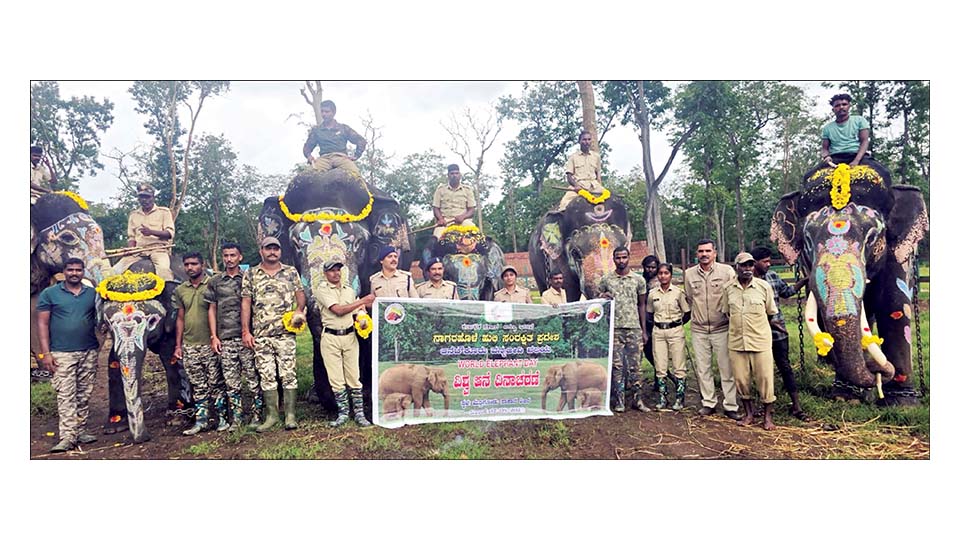
Chamarajanagar reported 134 deaths, Kodagu 126 deaths, Mysuru records 51
Mysuru: Today, Aug. 12, World Elephant Day, throws a harsh light on the growing crisis facing Asian elephants.
In Karnataka — home to the largest elephant population in India — over 380 jumbos have died in the past five years, with more than 64 deaths attributed to unnatural causes. Disturbingly, electrocution alone has claimed 50 of these lives.
Forest Department data from 2021 to 2025 shows that the State’s prime elephant belt — Kodagu, Chamarajanagar, and Mysuru — has lost 311 elephants. Chamarajanagar recorded the highest toll at 134, followed by Kodagu with 126 and Mysuru with 51.
While most deaths were due to natural causes, nearly one in eight elephants fell victim to man-made hazards. In Kodagu, electrocution emerged as the single biggest killer, with 30 deaths caused by low-hanging power lines, fallen cables and uninsulated electric fences.
Other unnatural deaths included five from gunshot wounds, two in road accidents and five from other causes.
Of the 380 elephants lost Statewide, 204 were adults (over 15 years), 77 sub-adults (5–15 years), 23 juveniles (1–5 years), 49 calves (under one year) and 23 newborns. Four deaths could not be age-classified as the carcasses were too decomposed.
In Kodagu, 103 elephants died of natural causes and 23 due to unnatural causes, 18 of which were electrocutions. In Chamarajanagar, 130 died naturally and four died unnaturally. Mysuru reported 41 natural deaths and 10 unnatural ones.
Undermining reproductive potential
Experts warn that the loss of 281 adults and sub-adults severely undermines the reproductive potential of herds. “Elephants in Karnataka are dying at an alarming rate of 8–10 percent annually,” said Surendra Varma of the Asian Elephant Research and Conservation Centre, Indian Institute of Science, Bengaluru.
“With Karnataka’s elephant population, a 2 percent five-year mortality is normal. But when it rises to 8–10 percent, it’s a crisis. No concrete measures are being taken and in the long run, this will be disastrous for the State, which is a haven for these pachyderms,” he warned.
The gender ratio further deepens the crisis — there is only one male for every three females and the ‘musth’ mating period lasts just about 20 days to two months a year on average.
Males are fit to mate between the ages of 15 and 40, meaning the death of so many adults and sub-adults will directly hit the birth rate.
“Sadly, we seem to remember elephants only during Dasara. Their silent deaths in the forests go unnoticed and even the Forest Department has failed to take adequate precautions to prevent these tragedies,” Varma added.
A 2015 High Court order had directed Chamundeshwari Electricity Supply Corporation (CESC) and other power supply companies to raise the height of electric poles to 11 metres and insulate all electricity wires to prevent dangerous exposure. However, the corporations have been installing poles only up to a height of 7 metres. The Court also directed them to insulate the wires to reduce risks. Despite repeated written communications from the Forest Department urging compliance, the safety measures remain unimplemented.
— Murthy, former Chief Conservator of Forests, Kodagu Circle




Recent Comments