


By Dr. Devdutt Pattanaik – Author, Speaker, Illustrator, Mythologist
Indian history shapes Hindu myth and Hindu myth shapes Indian history. Here are a few examples of how this happened.
Harappan bangles made of shell, clay and metal have been found in disproportionately large numbers, as compared to contemporary civilisations of 2000 BC. Later archaeological sites, further east in Hastinapur, dated to 1000 BC, show a shift in pottery styles (from black-red to painted grey) but continuity of bangles, now made of glass. Women in Buddhist stupas and Tamil epics wear bangles. Bangles are sacred, not cosmetic. Even today, bangles are integral to household rituals performed by the lady of the house. They are worn by brides, not widows and nuns. Their uninterrupted presence indicates continuity of Hindu ideas.
Hymns to horses in the Veda, dated to 1500 BC, indicate engagement with a new people, who introduced this new animal, domesticated only in 2000 BC in Eurasia, to India through Northwestern mountain passes. These men insisted that their sons (Putra), born of local women, never forgot the ancestors (Pitr) or the songs (mantra) of their fathers.
Tales of conflict between mighty Asura and trickster Deva, in Vedic ritual manuals, dated to 800 BC, reveals the eastward expansion of agricultural settlements in the Ganga river basin and encounters with new people. That even the enemy had the same father, Prajapati, evokes the complex relationships emerging between the immigrants who rode horses and venerated mighty eagles and natives who rode elephants and worshipped serpents.
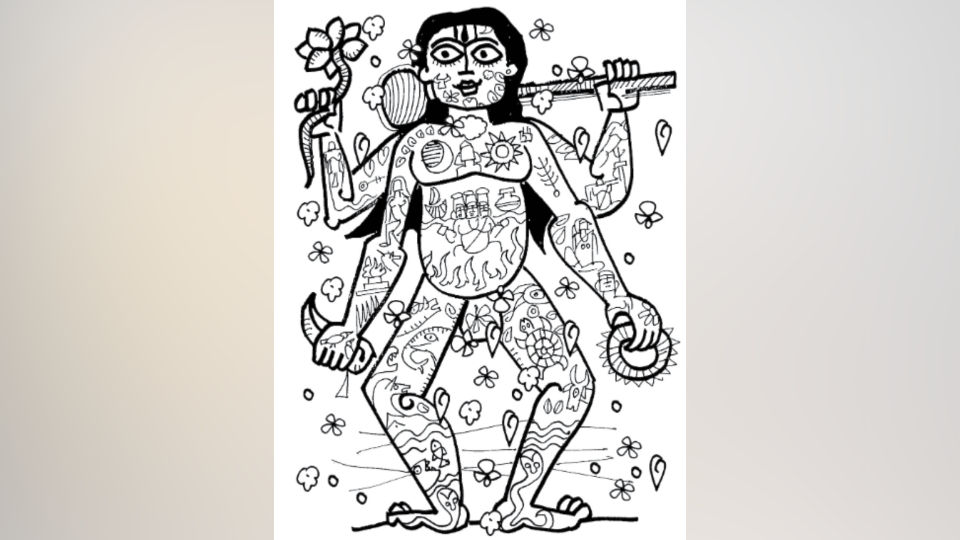
Rise of householder gods, such as Hara (Shiva) and Hari (Vishnu), marks the challenge to monastic orders such as Buddhism and Jainism that had become popular along long-trade routes, since 200 BC. Unlike hermits who preferred fasting to feasting, the new gods had multiple arms: two to feed themselves, the rest to feed others.
Replacement of Vedic rituals with temples that anchored circular (Mandala) kingdoms became widespread after 500 AD when Brahmins began to migrate to the South, West and Eastern corners of India, seeking royal patronage beyond the Yamuna-Ganga doab, which is always remembered as Antara-vedi, the innermost core of Arya-varta, land of noble people.
Shift from Tantrik ritualism involving wild animal-faced goddesses to Bhakti sentiment involving human-looking Ram and Krishna, after 1500 AD, happened when the court language shifted from Sanskrit to Persian. In a word dominated by Islam, divinity had to be singular, shorn of sensuality and preferably formless and always masculine. Human forms were preferred over animal and fantastic forms, with multiple heads and arms.
These ideas rarely make it to history textbooks. In colonial times, historians justified colonisation and civilisational glory. Indian history was seen as shifting from Hinduism (polytheistic, pagan) to Islam (monotheistic, religious) to British (atheistic, scientific, modern). In post-colonial times, historians see the past in terms of inequality and provide arguments for the pursuit of social justice. They see religion as a tool used by the elite to oppress people and so refuse to engage with myths. Nothing else.
Such a view of history is fractured and ideological. It ignores the power of culture, hence myth, in shaping human decision-making. There is no human culture without myth.



Recent Comments