


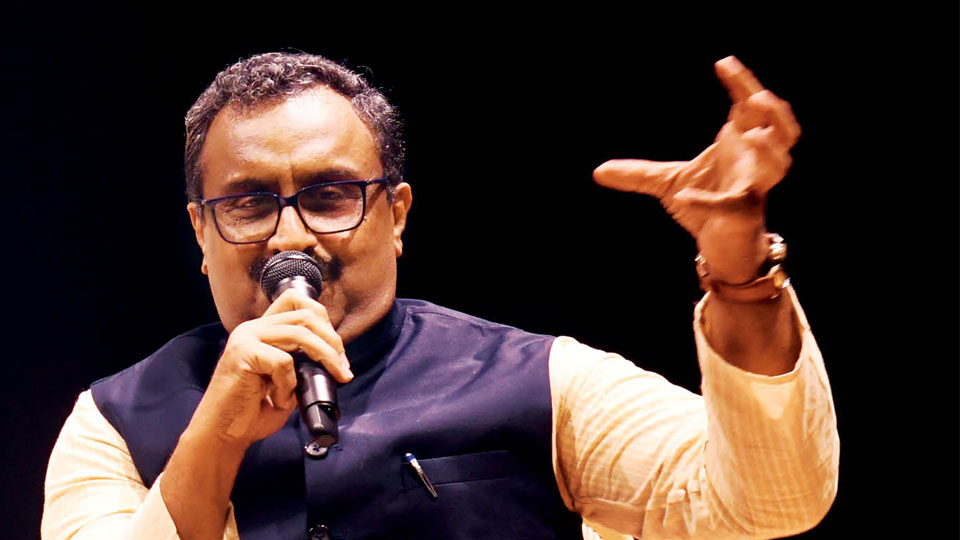
From an electrical engineer from Andhra Pradesh to RSS Swayamsevak to the National General Secretary of BJP (2014 to 2020), it has been a long, interesting journey for Dr. Ram Madhav. He is also a well-known author and is currently serving as the President of the India Foundation, a New Delhi-based think tank.
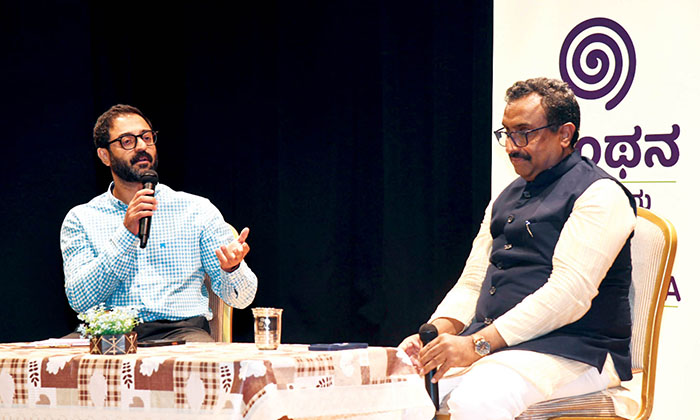
He recently visited Mysuru to take part in an interactive session titled ‘RSS 100 – Centenary Year of Rashtriya Swayamsevak Sangh (RSS)’ organised by Manthana Mysuru and Sri Jana Jagarana Trust, Mysuru.
Star of Mysore Managing Editor Vikram Muthanna caught up with Dr. Ram Madhav to know about the 100 years of RSS and what next? Excerpts…
Star of Mysore (SOM): The Congress Government in Karnataka is thinking of regulating or even banning RSS activities in public spaces and among its employees. What do you have to say for it?
Ram Madhav: Best of luck to them. I know it is not the Congress Government as a whole. It appears to be an agenda of a few leaders.
Probably, Congress in Karnataka is going through some internal turmoil and the RSS is being used to score certain political points.
But let me clarify one thing. We are not afraid of all these things. We have seen three big bans. I do not have records, but I have heard that when one such proposal came before Indira Gandhi, she told the Congress people that RSS is like a rubber ball; the force with which it is hit on the ground, it’ll bounce back with double that force. So don’t try to do such things with RSS.
Secondly, there are 30 different judgements in the last 100 years by different Courts. We actually published a book ‘Quotes on RSS’ which categorically said, of course, you cannot ban RSS in the first place and also you cannot stop any Government employee from attending its activity.
There is nothing political, nothing against the country in RSS activity. So you cannot impose any restriction on a Government employee from attending RSS activities.
So, let those who think that they can browbeat RSS for their own political ends just keep these judgements in mind. Additionally, if they don’t allow us to perform our ‘shaka’ in a given location, we will relocate to a different spot. This country is so vast and the hearts of our people are big; we have never had any dearth of space for our activities.
SOM: Earlier, you said it is difficult to understand RSS, but very easily misunderstood. I just want to know what we have not understood and what is that we have misunderstood about RSS?
Ram Madhav: Misunderstandings are many and you may want to know the reason for it. One is, of course, a few people in your State continuously propagate negative things about RSS and then there is the wrong presentation of its ideas on Hinduism and Hindutva.
Hindutva is always portrayed as RSS’ exclusive ideology. Let me be clear. What is Hindutva for us? If at all we are using that word, the only meaning of it is “Hinduism in practice.” But all such words have been misrepresented and misinterpreted to mean we are against some person or a community or a religion which has led to certain misconceptions.
That said I am ready to take 10 percent blame on us also. RSS remained an introvert organisation for many years.
In fact, RSS did not have a ‘Prachaar Vibhag’, the publicity wing until 1990s. RSS began in 1925, but for almost 70 years it did not have its own publicity department. So when people were attacking RSS, we were not responding and hence a negative image was allowed to be formed.
Dr. Subramanian Swamy once said, ‘You (RSS) are like a turtle.’ If you throw a stone at a turtle, it won’t react. It will simply withdraw its limbs under the shell. It will wait for you to get tired of attacking and stop.
Once you stop, it will then spread its limbs from the shell and start crawling again. He (Subramanian Swamy) said, you (RSS) are like that (turtle). You are tolerating these attacks and this reluctance to respond for decades has led to the misunderstanding of RSS.
RSS has now opened up and is proactively engaging with society and as a result, many misconceptions are being put to rest.
SOM: You once said that constitutionally, we are secular, but culturally, we are all Hindus. Can you explain what you mean by that?
Ram Madhav: Many people suggested that we should have the word secular in our preamble. This was in 1949. You know who said that there is no need for it? It was Dr. B.R. Ambedkar.
We as a society were always secular. In our own terminology we call it ‘Sarva Dharma Samabhava’, equal respect for all different faiths. So, Dr. Ambedkar said, why do you want to specifically introduce the word which will lead to more confusion? That said, we have to ask, between 1950 and 1976, before they added ‘secular,’ was India not secular?
We are not against the spirit of secularism; in fact, it is the very character of our society. But secularism, as is practised in our country today, is a pseudo version. It has turned into appeasement of a particular religion or a few religions and rejection of the faith of the majority of people.
That kind of pseudo version of secularism is what RSS said is not good for our country, because that goes against the very spirit of this country’s ethos.
Speaking of culture… The Rafale aircraft came last year. The first batch of those five landed at Chandigarh. Defence Minister Rajnath Singhji went to receive them. With him went a pujari. He had five lemons in his hands. He put those lemons under the wheels of the Rafale. Now is it secular or communal? For us, it is a part of our culture. Because we worship everything, we worship a ‘yudha viman’ (fighter jet) also.
SOM: Speaking on secularism, especially about minorities, they have an inherent fear of the RSS. Many ask, how would the RSS feel if a Muslim organisation had a large group of men in uniform and white caps and marched holding a ‘danda’ around the city? Would it not feel intimidating and discomforting?
Ram Madhav: Let me share some interesting facts. In the 1970s, Sanjay Gandhi had this brilliant idea. He said, like how the RSS has their daily ‘shakha’ where they do drills and march past, the Congress will also do.
He decided to have ‘Congress Shakhas’. The Congress tried for three months, four months. But who has that patience in the Congress party? So it never took off.
The communists also tried to do it in States like Kerala. They asked, “If you can do it, why can’t we do it?” and they did.
They also had those sticks and other things on their shoulders. They also had a uniform. They also had the march past. They could do it for two years, the third year, nobody turned up.
As long as it is within the realm of rules of the Government, within the realm of the Constitution, all other activities permitted, who are we to say nobody else should do it? But let them try. Not easy, sir.
To create that kind of discipline, to create that kind of training, needs a lot of motivation, not just antipathy for RSS.
Having said that, if somebody wants to do it, do it.
And about the stick, let me tell you. We kept it because we use it in our exercises. And if anybody today comes up and tells me it’s a weapon, somebody should laugh at them. Even dogs are not afraid of your sticks anymore.
In many of our route marches we don’t use sticks these days. Because, you know, RSS has a uniform and stick is not part of our uniform.
But to make stick into a dangerous thing is silly. We are in the age where all sorts of weapons are found in mohallas and gullies of our cities and stick is a weapon!? That misconception should go.
About the route march, it’s a kind of disciplined march we undertake. Many people undertake morning processions, Prabhat Pheries. It’s something like that.
SOM: You were in charge of J&K; in fact, you were sent from RSS to BJP for this purpose. What was your experience in stitching together a rare PDP-BJP government?
Ram Madhav: I was made in charge of Jammu and Kashmir and I think personally for me it was a great experience, but more importantly a good change in the minds of the people of especially Kashmir Valley.
Jammu has always been largely with the BJP and the Jansangh, but to make people in the Kashmir Valley understand the thought process of the BJP and RSS, we ran a Government for three-and-a-half years. The government helped in convincing people of Kashmir that the image of the BJP or RSS as somebody who is out to destroy all Muslims is totally wrong.
That is one of the major achievements of our participation in Kashmir in the government there and because of that, when we removed Article 370, there was not much opposition in the State.
Kashmiris understood that these people are not our enemies; actually, they want the good of the whole country, and that is why, when Article 370 was removed, the people of Kashmir were willing to see if it would benefit them. They lived under the rule of Article 370 for maybe 65 years. They wanted to see, without Article 370, if life could be better.
SOM: Has it been better?
Ram Madhav: I can tell you today, they all feel that without Article 370, life is much better than with Article 370 in the past. Today, the demand there is, “give us our Statehood back”, which is a legitimate demand. It has to get its Statehood back and it will get it.
But today, nobody really asks, give me Article 370 back. Not even in the Kashmir Valley.
SOM: You are a part of a whole global outreach programme. What was the outcome?
Ram Madhav: One of the major endeavours of Prime Minister Modi after he came to power in 2014 was a wider global outreach.
The idea was that India should be introduced to all as a rising civilisational power. In that process, I was also involved in a limited way.
We tried to connect with political parties which probably have this approach of respect for religion, respect for civilisational values and respect for ancestors. There are parties, like these conservative parties, in different parts of the world.
We also engaged with the Vatican and also with organisations like the Muslim World League. We are connected with them and we continue to work with them.
All this is helping dispel certain misconceptions about us. Secondly, it has also helped them understand India better.
SOM: What is the plan of RSS for the next 100 years?
Ram Madhav: RSS’ next 100-year plan is to continue its effort in creating greater unity in our society. But its immediate plan is ‘Pancha Parivarthan’, five transformations it wants to achieve. RSS is going to focus on them. I will just repeat those five: Kutumba Prabodhan (to strengthen our family system), Pariyavaran (climate), Swadeshi (instilling a sense of pride in selfhood), Souhardha (creating greater harmony in society) and Kartavyabodh (motivating people to know about social responsibility).
These are five immediate goals, but the larger goal would be to bring greater unity in the country.
In conclusion: Dr. Ram Madhav may be the most approachable and articulate face in this new phase of RSS, but he left many questions unanswered while his answers evoked many more questions.
None-the-less, one must appreciate the fact that while RSS may be perceived as a service organisation with a quiet aggressive streak, RSS is making slow but steady attempt to change that image.
How far it will succeed in bringing about the eradication of deep-rooted caste bias and harmony among all faiths is a challenge which will surely take another 100 years.
But let’s hope with their Kartavyabodh, they succeed in reminding people about their fundamental duties and in doing so fulfil Dr. Ambedkar’s wish — “I want all people to be Indians first, Indians last and nothing else but Indians.”
— Ed

Recent Comments