


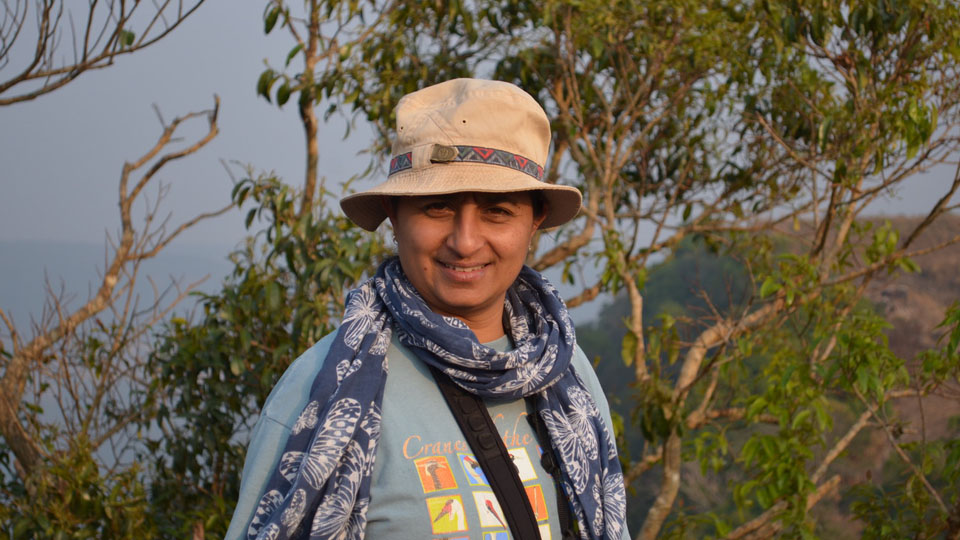
From studying hornbills to restoring degraded rainforests, tropical ecologist Dr. Divya Muddappa has dedicated nearly three decades to conservation in the Western Ghats…
Dr. Divya Muddappa, Senior Scientist at the Nature Conservation Foundation, Mysuru, has spent nearly three decades studying and protecting the rainforests of the Western Ghats. Her work in tropical ecology spans areas such as restoration ecology, conservation biology and plant-animal interactions, including seed dispersal and frugivory.
She began her research journey with the Malabar Grey Hornbill during her Master’s at the Salim Ali School of Ecology, Pondicherry University and later spent years studying hornbills across the Western Ghats, tracking their nesting patterns, distribution and the effects of rainforest fragmentation.
In a conversation with Star of Mysore, she says while her work in the forests has been deeply rewarding, the real challenge lies in convincing society, from the general public to policymakers, about urgency of conservation, especially when it comes into conflict with development and infrastructure projects. —Ed
By B.C. Thimmaiah
SOM: What first sparked your interest in tropical ecology? Was there a moment when you knew forests would become your life’s work?
Dr. Divya Muddappa: That’s an interesting question because we rarely look back and think about where it all began. For me, the turning point was a visit to Topslip in the Anaimalai Tiger Reserve, where one of my seniors was working. She took me on a walk into the forest.
It was my first time in a dense evergreen rainforest. Hearing the sounds of animals, seeing so many birds, especially hornbills, and standing among those towering trees was simply fascinating. It captured my imagination.
At the time, I was doing my Master’s and trying to decide on a topic for my dissertation. That visit eventually led me to begin my work on hornbills. Looking back, that was the moment my interest in rainforests truly began.
SOM: Can you describe your current field of work?
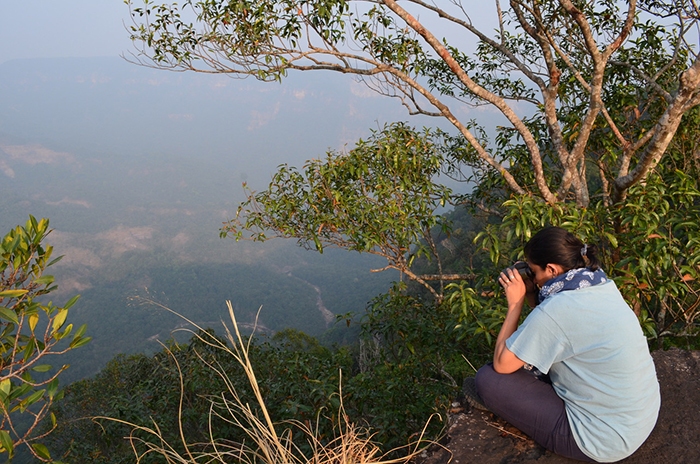
Dr. Divya: My work focuses on protecting and restoring tropical forests, particularly in the Western Ghats. A large part of it involves studying carbon sequestration and biodiversity conservation in landscapes already shaped by human activity.
I’m also involved in conserving globally threatened tree species through ecological restoration, especially in fragmented plantation landscapes. Another important aspect of our work is restoring degraded rainforests and abandoned plantations and monitoring how these ecosystems recover over time.
SOM: What was your specialisation in your dissertation?
Dr. Divya: I did my Master’s in Ecology and Environmental Science at Pondicherry University. For my dissertation, I studied the Malabar Grey Hornbill, a species endemic to the Western Ghats.
However, my work is not limited to hornbills. My broader area of interest is tropical forest ecology, particularly plant-animal interactions such as seed dispersal and frugivory. Hornbills, for instance, are important frugivores that play a key role in dispersing seeds across forests.
I later went on to study the brown palm civet, another endemic species of the Western Ghats, which is also largely frugivorous. My research looks at how different species interact with forests and contribute to ecosystem processes.
Currently, my partner, our team and I are working on restoring rainforests in fragmented landscapes in the Anaimalai region of the Western Ghats.
SOM: You’ve spent years working in remote rainforests. Looking back, what have been some of the toughest challenges you’ve faced in the field?
Dr. Divya: Personally, working in the rainforests of the Western Ghats has never felt like a challenge. I come from Coorg, so being in forests and observing plants and animals is something I deeply enjoy. The bigger challenge lies in conservation itself. One of the hardest tasks is convincing people that protecting nature is just as important as protecting our own future.
There are also larger pressures such as rapid development, habitat loss and the climate crisis. These make conservation far more complex. Ultimately, the challenge is helping people rethink their relationship with nature. Not seeing it merely as something to exploit, but as something we must learn to live alongside and care for.
SOM: Field research can be physically and emotionally demanding and unpredictable. Are institutions in India doing enough to make field science safer and more supportive for women?
Dr. Divya: Field research can certainly be demanding, perhaps more emotionally than physically, especially when you are young and starting out. But passion and the desire to conserve these ecosystems keep you going.
When I began working in this field, society was already quite gender-biased. But we were so driven by our interests that we rarely stopped to think about whether formal support systems existed. We simply carried on with our work. I’m happy to say that things have improved in recent years. Thanks to greater awareness and better policies, many institutions now have systems that offer support and protection. In many cases, these are gender-neutral policies that safeguard everyone.
That said, we still have a long way to go. Many challenges women face come not from institutions but from broader social attitudes. Addressing those requires bigger behavioural and cultural change.
SOM: From when you began your career to where you are today, how do you see the journey of women in Indian wildlife science?
Dr. Divya: The journey has been encouraging. Compared to many other scientific fields, wildlife science has generally been more welcoming to women. Even when I started, women were working in the field, perhaps not many, but certainly some.
We were also fortunate to have strong role models. Some of my professors were women who influenced my work greatly and there were inspiring women scientists globally as well.
Today, it is also encouraging to see more women officers in the Forest Department, something that was far less common earlier. The bigger challenge is often whether women are able to continue their careers over the long term.
SOM: Wildlife biology requires patience and long-term commitment. Do women bring a different perspective to conservation work?
Dr. Divya: We are definitely seeing more young women entering the field today. In many academic programmes, the numbers are almost evenly split between women and men. I do think women bring a different perspective to conservation work. It is not necessarily better or worse. Just different, and that diversity is valuable. People observe and interpret nature in different ways.
Some studies suggest that women tend to make very detailed behavioural observations, particularly when studying social animals such as primates or elephants. Qualities like sensitivity, empathy and openness can shape how we observe and understand wildlife. In my experience, women may also be less driven by competition in a negative sense and more inclined towards collaboration, which is very important in conservation work.
SOM: What do you tell young women who are passionate about ecology but unsure about taking it up as a career?
Dr. Divya: Ecology and wildlife conservation are fields where the line between a hobby and a career can sometimes be very thin. For many people, it begins as a hobby and gradually becomes a profession.
But I often say that you don’t necessarily have to make it your career to contribute to conservation. You could be a lawyer, doctor or engineer and still make a meaningful difference through the choices you make and the way you live.
What matters most is having a genuine connection with nature. That connection can exist whether you are a professional in the field or simply someone who loves and respects the natural world.
SOM: On International Women’s Day, how do you define leadership in science and conservation, especially in the Indian context, where some fields are still viewed through a gender lens?
Dr. Divya: Leadership, in my view, is not about gender. It is about the qualities a person brings to the field. Traits such as empathy, sensitivity, determination, patience and the ability to collaborate with the team or group are essential for good leadership.
These qualities are not limited to any one gender. Rather than asking whether men or women make better leaders, the real question is whether a person possesses the qualities needed to lead effectively.
Ultimately, I hope more people recognise the importance of protecting nature and maintaining a clean and healthy environment. Because our own survival depends on it. I also hope more people come together to protect the natural ecosystems we still have left.



Recent Comments