


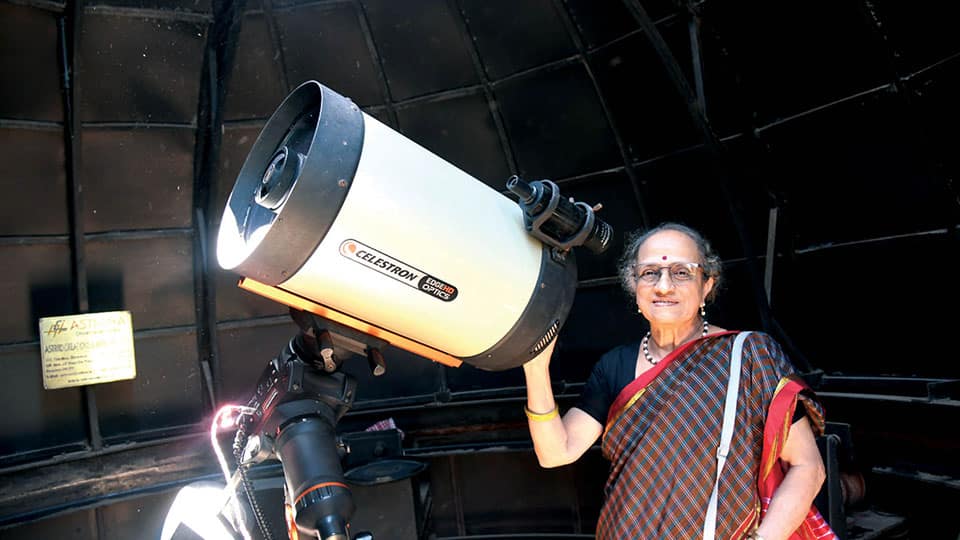
Dr. B.S. Shylaja, former Director of Jawaharlal Nehru Planetarium, Bengaluru, says Mysuru Planetarium will make astronomy more accessible
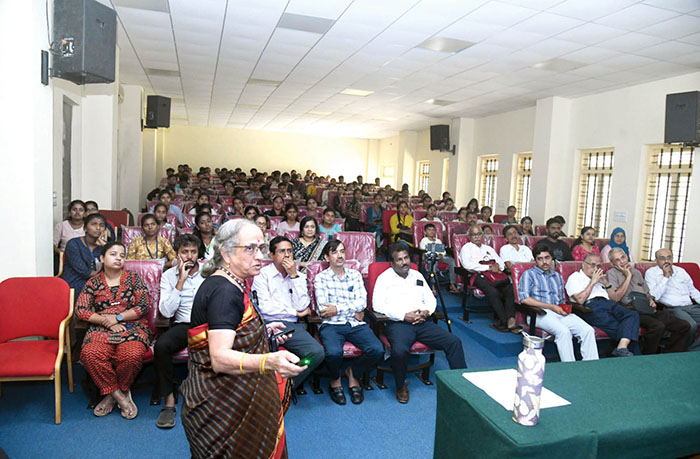
Dr. B.S. Shylaja, a distinguished astronomer, Visiting Scientist and former Director of Jawaharlal Nehru Planetarium, Bengaluru, was in Mysuru recently to deliver special lectures titled ‘Spectroscopy — A Tool to Understand the Inaccessible’ at the Physics Department in Manasagangothri and ‘Astronomy in Temples — Architecture, Art and Time-keeping’ at the Wadiyar Centre for Architecture.
With decades of experience in astronomy education and public outreach, she has played a key role in developing planetarium programmes, teaching astronomy and also initiated a monthly sky watch programme called ‘Know Your Stars.’ On behalf of Star of Mysore, Sujata Rajpal caught up with Dr. Shylaja. Excerpts:
By Sujata Rajpal
Star of Mysore (SOM): Could you share your experience at the Jawaharlal Nehru Planetarium in Bengaluru and tell us how the planetarium evolved?
Dr. B.S. Shylaja: It was commissioned in 1989, though I joined the team in 1994. Before that, I was a scientist at the Indian Institute of Astrophysics. Our team, including engineers, was guided by Prof. C.V. Vishweshwara, the Founder-Director. Everything was new and we had to start from scratch. Initially, we had only a sky projector and very limited support. Over time, we added slide projectors and video projectors.
Earlier shows were mostly live lectures with the presenter pointing at the screen. Unlike today’s digital tools, we had to do everything professionally for the 4K dome projection. We produced about 25 programmes. As the content matured, we introduced professional voice-overs and gradually included local music to enhance the experience. As media technology evolved, we also started incorporating videos and visualisations. Our programmes attracted students as well as general public.
SOM: What were the major challenges faced while running the Bengaluru Planetarium?
Dr. Shylaja: Every aspect was a challenge, from preparing the content to visualisation. We had to keep the stories short and engaging because the audience can’t sit through long shows in the sky theatre. We developed new content each year on eclipses, comets, constellations and rare events like the transit of Venus.
Each planetarium in India operates independently. The programmes made for Bengaluru couldn’t simply be used in any other planetariums, unlike what happens abroad, where the same programme might be shown in multiple cities. This uniqueness meant every planetarium had to develop its own content, tailored specifically to its equipment and audience.
SOM: Does having narration in Kannada help?
Dr. Shylaja: Absolutely. Students learn better when complex concepts are explained in their mother-tongue. Every programme in Bengaluru has been presented both in Kannada and English because we need to reach the local audience. We also specifically cater to rural children by scheduling special shows and activities for them, so it’s important to have narration in Kannada.
SOM: Do you think planetariums help bridge the gap between classroom education and the study of astronomy?
Dr. Shylaja: Definitely. Astronomy isn’t usually taught in schools anymore. Many of the things that were common knowledge 200 years ago are now unknown to today’s students. In earlier times, students at high school and college levels did learn about the solar system and celestial phenomena in detail, but for some reason, it was removed from the curriculum across India.
SOM: How has planetarium technology evolved in India over time?
Dr. Shylaja: The evolution of planetarium technology is part of a global phenomenon. One of the pioneering companies is Carl Zeiss from Germany, which has been making planetarium projectors for over 100 years. Their instruments are known for durability and often last decades without issues. The first generation of projectors was mechanical devices without electronics or computer control, yet many still function perfectly today, including the ones we used.
However, we eventually needed to upgrade because these older systems lacked support for digital synchronisation with videos, audio and modern visualisations. New digital projectors allow integration with advanced media, which enhances the experience.
Artificial Intelligence (AI) will likely make things better and more advanced, but the foundation was already laid well before AI became popular. For example, we have a programme demonstrating how Yuri Gagarin rotated a pencil in microgravity, simulating space conditions.
SOM: The upcoming planetarium in Mysuru will feature a 15-metre dome with 8K resolution. What kind of experience will such an advanced LED dome offer?
Dr. Shylaja: I am not involved with the upcoming planetarium in Mysuru, but I’m very much looking forward to experiencing this new technology. As I have been informed, this new planetarium uses a completely different technology compared to older ones. Previously, we had hybrid systems where stars were projected by an automatic mechanical system combined with digital visualisations. The Mysore planetarium will have a 15-metre LED dome, similar in size to Bengaluru’s, but the LED technology will provide much sharper and more vivid images, much like how old CRT TVs have been replaced by modern LED screens, offering superior picture quality. The Mysuru experience will rely more on high-definition digital visuals.
SOM: How significant is this development for Mysuru city’s scientific landscape?
Dr. Shylaja: While Bengaluru has done tremendous work, especially reaching rural areas, the city can only serve a small percentage of the population due to logistical challenges. So, having facilities like the planetarium in Mysuru will help expand access to astronomy education. The city will definitely become an important hub for astronomy learning and research.
Star of Mysore (SOM): Does studying science help develop a scientific temper in people? How can planetariums help in this?
Dr. Shylaja: The purpose of planetariums is to nurture rationality and encourage scientific thinking. Without scientific understanding, the sky can seem mysterious, leading people to believe in superstitions. But when we explain the truth about what’s in the sky, the physics and mathematics behind it, it helps dispel those superstitions.
Even if superstitions exist at home, children start questioning and developing their own reasoning over time. This generational shift is gradual, but it’s real. 40 or 50 years ago, a total eclipse would bring a curfew-like situation everywhere; no one would go outside and events were cancelled. Now, attitudes are changing and science is becoming more accepted. While understanding science, it is important to respect traditions and draw the line between tradition and science.
SOM: There is a common superstition that people shouldn’t eat during a solar eclipse. Is there any scientific basis for this?
Dr. Shylaja: Honestly, I don’t know how that superstition started. There’s no scientific reason for it and it is not mentioned in the Vedas or other traditional texts that people should not eat during an eclipse.
What is scientifically true is that even on a regular day, you should not look directly at the sun at any time of the day except for a few minutes’ window at sunset and sunrise.
At all times, the sun is very bright and staring at it can damage your eyes, whether it’s an eclipse or a non-eclipse day. During an eclipse, people get curious and want to look at the sun because something unusual is happening, so perhaps that’s why there are warnings to avoid looking at the sun to protect eyesight.
SOM: What advice would you give to women interested in pursuing science?
Dr. Shylaja: Science often feels intimidating and unfortunately, many girls grow up believing they aren’t good at mathematics or science, while boys are seen as naturally better.
Up to the Pre-University level, it’s important to explore all subjects. After that, if they’re interested in science, they should pursue it wholeheartedly.
Many young people are pushed into engineering just because it is seen as the only viable future.
Talented individuals in music or the arts often get diverted into engineering, which wastes their potential and also denies opportunities to others. This attitude needs to change.
Parents and society must stop viewing engineering as the only path to success and respect all fields equally.
Recent Comments