


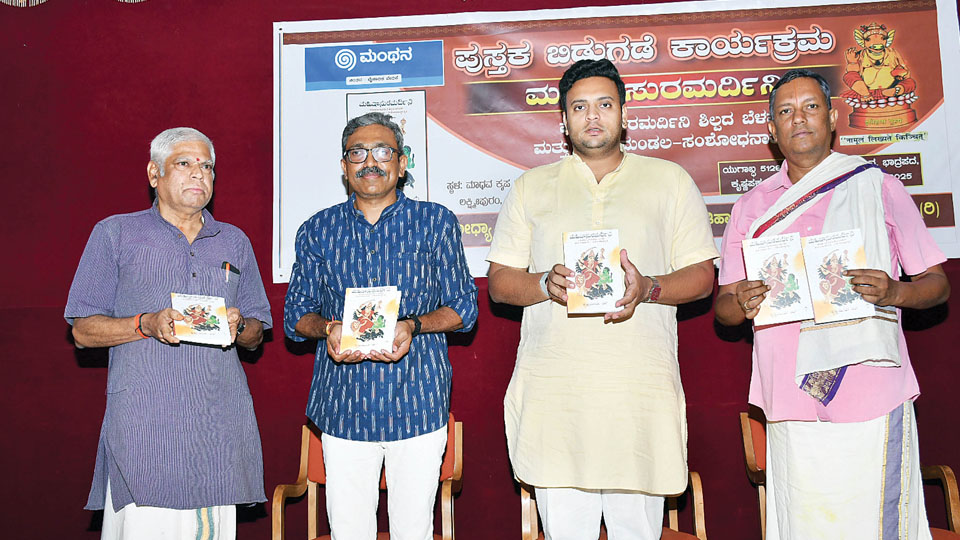
Dr. Shalvapille Iyengar says Dasara’s symbolic battle — knowledge Vs ignorance — must be preserved
Mysore/Mysuru: Amid rising ideological debates over the symbolism of the famed Mysuru Dasara, scholars and cultural historians have voiced concerns that the city’s rich heritage and identity could be undermined if the festival’s sanctity is diluted.
Speaking at the launch of the research-based book ‘Mahishasuramardini’, authored by R. Krishnamurthy, Dr. Shalvapille Iyengar, Professor at the Department of Ancient History and Archaeology, Karnataka State Open University (KSOU), cautioned that tampering with the philosophical core of Dasara could erode Mysuru’s cultural ethos and historical pride.
The event, held at Madhava Krupa Hall in Lakshmipuram, was jointly organised by Ayodhya Publications and Manthana Mysuru. The book explores the evolution of the Mahishasuramardini and the concept of Mahishamandala, offering a deep dive into historical and cultural interpretations.
Symbolism under scrutiny
Addressing debates questioning the portrayal of Mahishasura and Chamundeshwari, Dr. Iyengar said such discussions are healthy but must remain constructive.
“Debates are necessary,” Dr. Iyengar noted, “but they should be a vishaya manthana (churning of ideas), not a vishada manthana (toxic churn).”
He explained that Dasara celebrates the triumph of knowledge over ignorance. Chamundeshwari represents wisdom, while Mahishasura — depicted with a buffalo head — symbolises ignorance.
Rituals rooted in sovereignty
Dr. Iyengar traced the festival’s roots to ancient practices where rulers worshipped weapons as symbols of strength, protection, and peace. “Just as a nation relies on its army to safeguard borders and Police to maintain internal order, weapons represent the instruments of defence,” he said.
During Dasara, the Mysore royal family traditionally worships swords, elephants, cows, and horses — not merely as ceremonial pageantry but as symbols of sovereignty and cultural continuity, he emphasised.
The book also highlights how the Mahishasuramardini evolved into a symbol of resistance during British rule. In 1873, playwright Kiran Chandra Bandopadhyay depicted her as Bharath Matha in his drama, inspiring nationalist fervour.
Later, Bankim Chandra Chatterjee’s hymn ‘Vande Mataram’ in his novel Anandamath (1882) became a rallying cry for India’s freedom struggle.
Mysuru’s 400-year legacy
The book traces the region’s transformation from ‘Mahisuru’ to ‘Mysuru,’ uncovering its Buddhist heritage and the significance of nine sacred sites.
The book also examines the Mahishmati-Mandaleshwar and Mahishamandala concepts, linking them to Mysuru’s historic and cultural landscape.
Preserving tradition “Preserving the sanctity of Mysuru Dasara is a collective responsibility. It is not just a festival, the very soul of our cultural identity,” Dr. Iyengar appealed on the occasion.
Recent Comments