


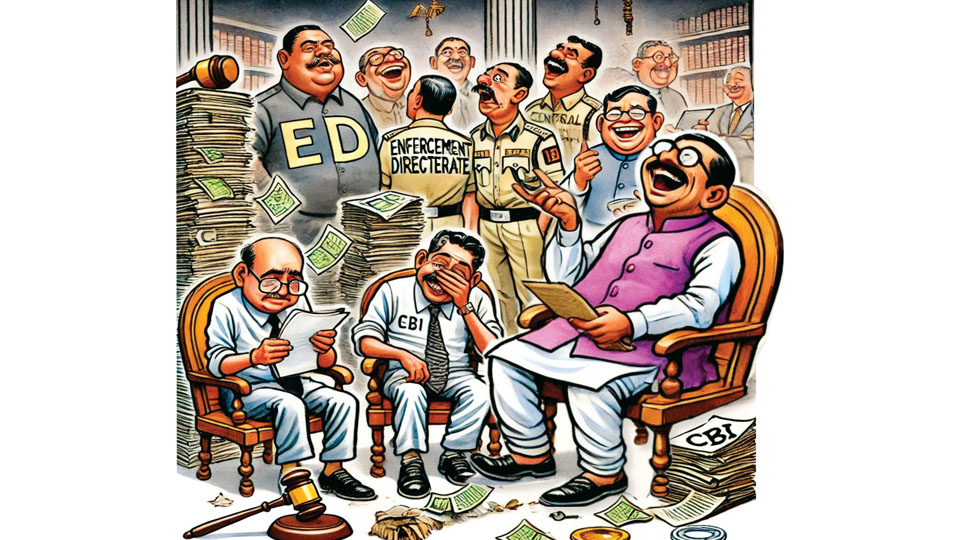

Yesterday, a Special Court under the Delhi High Court discharged former Delhi Chief Minister Arvind Kejriwal, his deputy Manish Sisodia and 21 others in the now-famous liquor policy case.
For the Aam Aadmi Party (AAP), it was a celebratory ‘Patiala peg’ served neat by the incompetence of the CBI, giving them a political high against the BJP.
For the investigative agencies, however, the morning hangover has arrived with a judicial headache.
Special Court Judge Jitendra Singh observed that the CBI did not disclose “even the threshold of a prima facie suspicion,” thus making the claims “wholly unable to survive judicial scrutiny and discredited in entirety.”
So, the CBI, let alone being able to produce sufficient evidence or weak evidence, failed to show “even the threshold of a prima facie suspicion” !
Courts often find evidence in a case inadequate, but rarely do they find suspicion itself missing. Yet the CBI filed a 200-page chargesheet in the case.
This makes one wonder what the hell was in the 200-page chargesheet that CBI filed then?
Was it a 200-page fiction novella? Or was it a 200-page election playbook, ghost-written by the BJP to snatch the Delhi elections?
We have to assume the former, considering the Court called the probe a “premeditated and choreographed exercise” and even ordered a departmental inquiry against the investigating officer for framing charges without material evidence !
The larger issue is not this one case. It is the growing perception that all political parties use agencies like the Enforcement Directorate (ED), the Central Bureau of Investigation (CBI) and the Lokayukta as instruments of politics.
The pattern is familiar: Raid, seizure, arrest, headline and then… silence. Years pass. Courts intervene. Cases collapse or languish waiting for negotiations.
Luckily for Kejriwal, all this happened within two years. But he still had to be in jail for 150 days and his Deputy had to spend 510 days in jail.
Will the erring investigating officers be dismissed? Will Kejriwal and his Deputy be compensated? Who will be held accountable?
No one. Because the CBI will keep this in a perpetual loop of ‘appeals’ and ‘adjournments.’
Our investigating agencies have a dismal record of securing convictions.
The ED secured its first-ever conviction under the PMLA (Prevention of Money Laundering Act ) 12 years after the Act came into force.
As of today, out of 5,297 cases lodged under PMLA, only 40 convictions have been achieved and of these, three were acquitted !
The CBI fares no better. According to a 2023 report by the Central Vigilance Commission (CVC), over 6,900 corruption cases investigated by the CBI are still pending trial.
Of these, 361 cases have been pending for more than 20 years !
Speaking of incompetence, some may recall the ‘Naval War Room Leak’ case where Lt. Commander Ravi Shankaran (Retd.) stole classified documents and passed them to a defence contractor, to secure a 3-billion-pound submarine deal with the Indian Navy.
Despite being arrested twice by the CBI, Shankaran escaped both times from the clutches of the CBI.
Eventually, he surrendered in London, but in 2023, a British Court quashed his extradition.
The Court ruled that India had failed to even present a prima facie case against him.
It’s shocking that after 10 years, our investigating agency couldn’t even make a case that prima facie showed there was a case !
Adding insult to injury, the Court criticised India’s ‘sluggish’ judicial system and ordered the CBI to pay Shankaran over Rs. 1 crore for his legal expenses. Similarly, Vijay Mallya’s extradition case revealed systemic delays.
In 2017, a UK Judge mocked India’s legal procedures and investigation saying, “Are Indians normally very prompt in their responses? They have taken six months so far and we haven’t gotten any further?”
The delays and lack of strong evidence allowed Mallya to enjoy extended bail. It’s been 9 years. He is still in London. Happy and free.
Maybe the CBI, after all, doesn’t have a case against Mallya. So, they’ve chosen to leave Mallya in London happy and free, rather than go to trial and embarrass themselves as they have in Kejriwal’s case.
Even at State-level, the Karnataka Lokayukta registered 4,680 cases between 2000 – 2021 and had convictions in 878 cases, which is a strike rate of just 18% !
To better the Lokayukta, the Karnataka Government formed Anti-Corruption Bureau (ACB). This institution had booked 1,814 cases, of which convictions took place in just 10 cases. That’s a conviction rate of 0.55% ! Now, rightfully ACB has been shut and Lokayukta is back.
With this in context, politicians have little reason to fear the investigating agencies.
Evidence and investigations are more likely to be used as bargaining chips in political negotiations rather than as instruments of justice.
In the end, the real casualty is not a politician or a political party. It is institutional trust. And when investigative agencies lose credibility, it makes a democracy shaky. Thankfully, we have four pillars and one of them acted promptly in Kejriwal’s case yesterday — The Judiciary.
e-mail: [email protected]



Recent Comments