


By Dr. K. Javeed Nayeem, MD
In my last week’s article, I had written about how the erection of the statue of H.H. Chamaraja Wadiyar X, our 23rd Maharaja, in front of our Palace, ran into a bit of a problem and how it was solved in a most ingenious way, paving the way for it to become our city’s most well-known landmark.
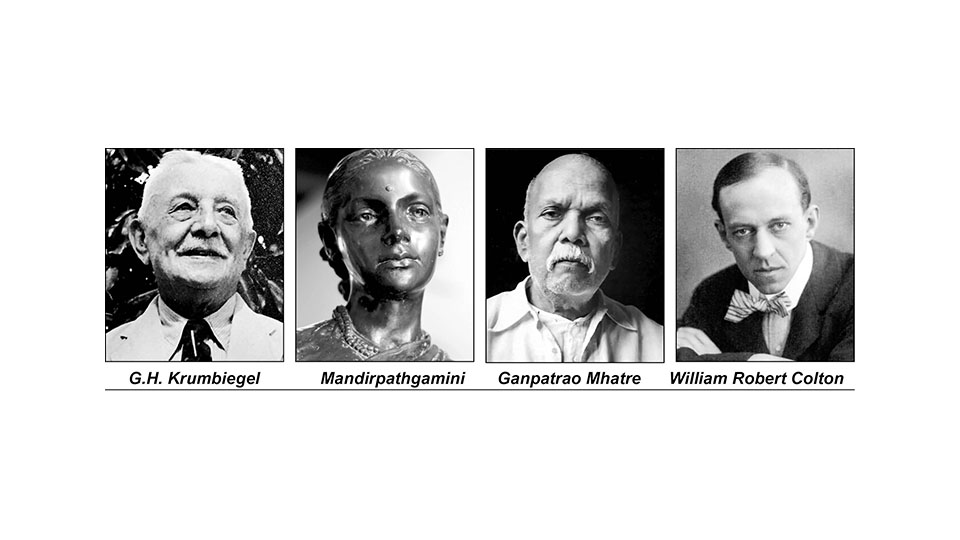
This statue, that was originally sculpted by the famous French sculptor, William Robert Colton, due to a major imperfection, was given a completely new head that was sculpted by Ganpatrao K. Mhatre, a no less famous artisan from Bombay.
While the former completed the work assigned to him in the year 1918, the statue after its corrective plastic surgery by the latter, could be installed and unveiled at its present location, only in the year 1920.
Colton, as a result of his expertise and reputation, had received a series of private commissions from the Maharaja of Mysore, including at least four busts and statues of him and he continued to regularly secure work from many other places in India.
In the period 1905 to 1918, he exhibited his creations meant for India regularly at the Royal Academy and among his works shown there were the bronze busts of H.H. The Maharaja of Mysore and Sir Sheshadri Iyer, the Dewan of Mysore. Colton had been hailed in his field as a master craftsman when it came to bringing out the exact likeness of the personalities whose statues he sculpted and he had more than fifty works to his credit, located across the world.
But most unusually, he somehow failed in getting his work to win the acceptance of our Maharani Vani Vilasa Sannidhana Kempananjammanni, after which he had to beat a retreat from India, for good.
After a distinguished career as both sculptor and teacher, Colton died on 13 November 1921, at the relatively young age of 53. At the time of his death, he was serving as the President of the Royal Society of Sculptors and it has been placed on record that his wealth, at the time of his death, was 19,742 pounds, a princely sum indeed, in those days of kings, queens and princes!
Ganpatrao K. Mhatre too was no less well-known a man in his field, although his talent never crossed the shores of our country, in his lifetime. Later conferred with the title ‘Rao Bahadur’, he too is credited with having sculpted the busts and full statues of many great Indian personalities. But, undisputedly, his most famous creation is ‘Mandirpathagamini’ the statue of a young Maharashtrian lady, draped in a nine-yard saree, holding a plate of pooja items in her hand, on her way to a temple, with an almost imperceptible smile on her face!
It can now be viewed at the Sir Cowasji Jehangir Hall at The National Gallery of Modern Art in Mumbai and it was praised for its excellence by Rabindranath Tagore as one of the best pieces of Indian art. A student of the famed J.J. School of Art, Mhatre has undoubtedly outdone Colton when it comes to the number of works he has executed.
His great grandson, Dr. Hemant Pathare, a Mumbai-based surgeon, who is writing Mhatre’s biography, is right now on a quest to trace all the 372 sculptures made by his great grandfather, who took the art world by storm in the 19th century. He has located 280 figures so far and among the ones he is still looking for are an image of the Goddess Saraswati standing on a peacock, that went missing from a Sangli Museum, a marble statue of Lord Rama, a bust of King George V that disappeared from a Gujarat College and another of Sir William Dring of the East Indian Railway Company, that once stood at the Howrah Railway Station.
Nearer home, are the statues of Maharaja H.H. Chamaraja Wadiyar X and Sir Mark Cubbon, located at the Cubbon Park and more notably, the bronze equestrian statue he has sculpted of our Maharaja, that now stands in the statue park of Lalbagh, in Bengaluru. This statue was actually meant to be here in Mysuru where it stood just for a few years at the Curzon Park, adjacent to the Palace, before it was shifted to Lalbagh by the German botanist Gustav Hermann Krumbiegal in the year 1908, when he was the Superintendent there.
In 1907 this man who was working at the Botanical Gardens at Ootacamund, accepted a personal offer from H.H. Maharaja Krishnaraja Wadiyar, the ruler of Mysore to serve him and most interestingly, he was reportedly the only man accorded the courtesy of shaking hands with the Maharaja whenever they met!
The Dewan of Mysore appointed him as an architectural consultant despite protests from the British Resident in Mysore that the Crown should not have a German in its service.
During the Second World War, Germans in India were declared as enemies by the British and Krumbiegel was, along with other Germans, held for some time, at an internment camp in Bengaluru.
Undeterred by this bad patch in his life, Krumbiegel continued to live in Bangalore, even after his retirement, till his death in 1956. He was buried at the Methodist Cemetery on Hosur Road, Bengaluru and in 2016, 60 years after his death, Krumbiegel’s grave was given a facelift by the Government of Karnataka, in honour of his contributions to the State.
The Road, running between the main and the West gates of Lalbagh, is named after him. In the comfort of his refurbished grave, Krumbiegel is now perhaps having the last laugh that it was the British who were ousted from India, while he was given a permanent home here!
[Just one more statue, waiting in the wings, to make an entry into this column, next week!]
e-mail: [email protected]
Recent Comments