


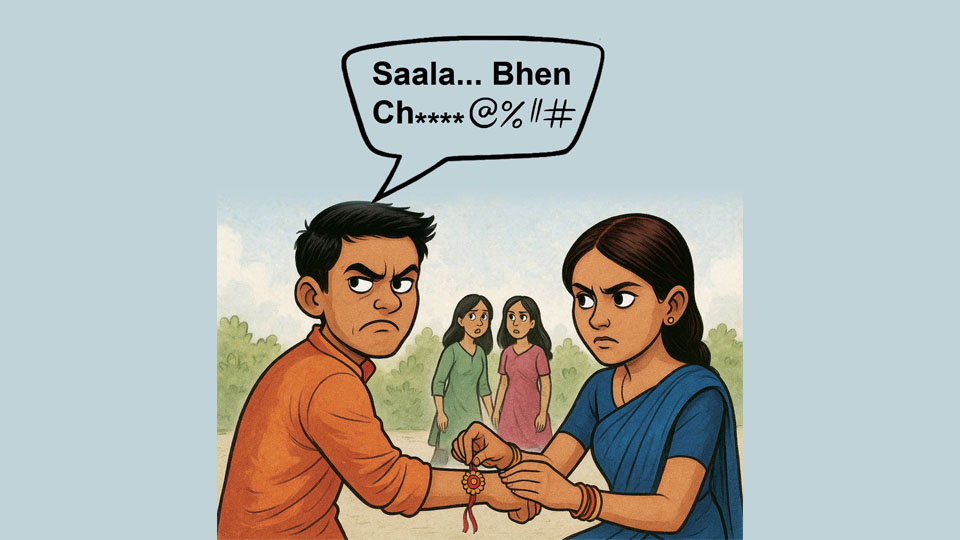

Today is Raksha Bandhan, when sisters tie a sacred Rakhi on their brothers’ wrists as a pledge of love and prayers for their well-being, and brothers vow to protect them from harm.
The issue today is that most Indian men have forgotten the real essence of Raksha Bandhan, which is to respect and protect all women, not just your sister, mother, or wife while happily abusing someone else’s.
And when it comes to abuse, India has a rather ironic record.
We take pride in our women-centric festivals, Goddesses and women leaders, yet our most common insults are aimed at women. More specifically, fornicating with someone’s mother or sister. They don’t even spare grandmothers.
In our ‘cultured’ city of Mysuru, arguments often begin with “nimmajji…” (your grandmother) or “nimmakkan…” (your elder sister). For some reason, no one goes after younger sisters !
English has “motherf*****.” Hindi has “madhar c**** and bhen c****.” Perhaps it’s time for equality in vulgarity.
Women could start saying “fatherf*****”, Hindi speakers might try “baap c***” or “bhai c***.” In Kannada, “nimmthathan…” (your grandfather’s), crude but a refreshing change.
Jokes aside, misogynistic cursing is harmful because language shapes culture. The words we use daily influence behaviour, attitudes, and even public safety.
The normalisation of gendered insults reinforces disrespect towards women, and disrespect often tends to escalate into harassment or violence.
This problem is so ingrained that Prime Minister Modi addressed it in his 2022 Independence Day speech.
“We have been casually using expletives and cuss words, which are abusive and against our women. Can we not pledge to get rid of every behaviour and culture that humiliates and demeans women?” he asked.
So dear brothers and fellow men, this Raksha Bandhan, right after vowing to protect your sister, maybe we can also stop cursing someone else’s?
But there’s another twist to the ‘protection’ promise. Which is when it mutates into the concept of ‘family honour.’
Brothers sometimes become so protective that they attach their own honour, self-worth and dignity to their sisters’ choices.
In doing so, they suffocate their sisters’ freedom; policing her career, her clothes, her friendships, and finally her marriage, all in the name of safeguarding ‘her dignity’. The extreme version of this ends in honour killings.
Sometimes even progressive brothers slip into patriarchy without realising it, smothering their sisters under the guise of care.
The protection of your sister should never mean her imprisonment. Raksha Bandhan is a brother’s commitment to stand by his sister’s choices. Supporting her dreams and standing against societal norms that seek to oppress or limit her.
Indian brothers must understand that protecting your sister is allowing her to live her life… live her life like you do.
So, let her be… let her be like you, free and fearless. Protect her from people who won’t let her be herself.
Meanwhile, sisters, be careful that Raksha Bandhan does not slip into materialistic irreverence where it’s about tying Rakhi to get a gift more than love and protection. Then you will definitely get patriarchy instead of a brother’s love or protection.
Of course, Raksha Bandhan has its lighter, slightly absurd side too.
First, the menace of the ‘non-blood related Rakhi brother’. These are the boys who hang around women as ‘brothers’ while secretly hoping to upgrade to ‘boyfriend.’
Women, of course, have their own counter-racket. When rejecting a man, and sensing he might turn unpleasant, they deploy the magic spell: “You’re like my brother.” And seal it with a Rakhi.
After this, he’s trapped in permanent chaperone duty or turns into a mean bodyguard, hoping that next year his position will be promoted from the present driver to her lover.
Then there’s the moral Police. These self-appointed guardians of culture have a bizarre habit of forcing young couples in parks to tie Rakhi to each other, instantly turning a romantic relationship into an involuntary sibling relationship. This is not morality, this is perversion.
In the end, Raksha Bandhan should remind us, men, of the values and spirit of this festival.
As men extend their wrist for a Rakhi to be tied, they should ask if they are being respectful of all women, and may think twice before screaming “bahin c***”. For…
As Lao Tzu said…“…watch your words, they become your actions; watch your actions, they become your habits; watch your habits, they become your character; watch your character, it becomes your destiny.”
The destiny of Indian women’s safety lies, in large part, in the behaviour of Indian men. Maybe we can encourage Indian men to start with something as simple as kind words this Raksha Bandhan.
e-mail: [email protected]




Recent Comments