


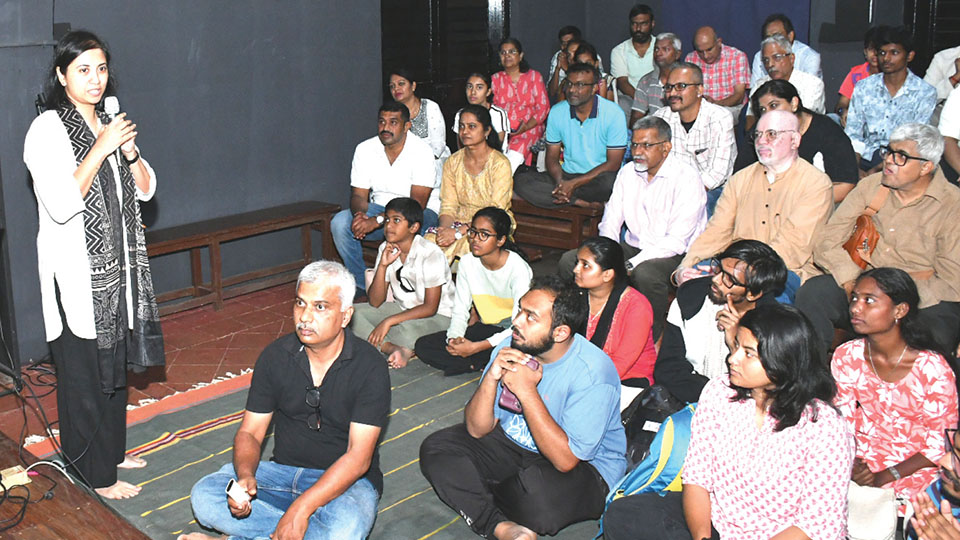
Noted Archaeozoologist Dr. C.V. Sharada speaks on new horizons on old worlds
Mysore/Mysuru: Archaeological science is vital for understanding artefacts and objects hidden beneath the earth’s surface, said Dr. C.V. Sharada, noted Archaeozoologist and environmental archaeologist and Assistant Professor, IIT-Gandhinagar.
She was addressing a Mind-to-Mind session on ‘New Horizons on Old Worlds — Exciting Scenarios from Archaeological Science,’ organised by the Indian Institute of Educational Theatre (IIET) at IIET, Hardwicke School Campus, JLB Road, yesterday.
As a faculty member associated with Archaeological Sciences Centre at IIT-Gandhinagar, she leads ‘Interspecies Research Network,’ a multidisciplinary research group exploring areas like zooarchaeology, human-animal studies, cultural studies, multi-species anthropology & forensic bio-geoarchaeology.
Useful resources from waste
The talk was a fascinating glimpse into her interdisciplinary work, highlighting connections between archaeology and natural sciences.
Pointing out that archaeology mainly involves excavation & scientific study, Dr. Sharada stressed the need to create useful resources from waste and adopt scientific methods in research. “Archaeology focuses on studying artefacts and objects found beneath natural soil layers. The study of fossils and remains of ancient plants and animals must be carried out within the framework of the law. Artefacts discovered during excavations should not be taken away without permission from competent authorities, and research on them must be conducted with due approval,” she said.
Sharing insights from her extensive expeditions and her evolution as an archaeological scientist, Dr. Sharada also noted that advanced technologies are being used in archaeological research. “Small robots are deployed to explore deep inside Egyptian pyramids, whose outer layers are covered with massive stone blocks,” she explained.
Indus and Harappan Civilisations
Stating that archaeological studies have greatly contributed to understanding ancient and present-day lifestyles, she highlighted how research has helped scholars study the Indus and Harappan Civilisations.
Describing archaeology as a scientific discipline involving observation, questioning, hypothesis, experimentation and conclusions, Dr. Sharada said, the field also helps researchers understand social systems, cultural patterns and practices in India and across the world. “Archaeology also contributes to a better understanding of botany and zoology. I have studied several skeletons and fossils of ancient animals, including dinosaur remains in Gujarat that are believed to be thousands of years old,” she added.



Recent Comments