


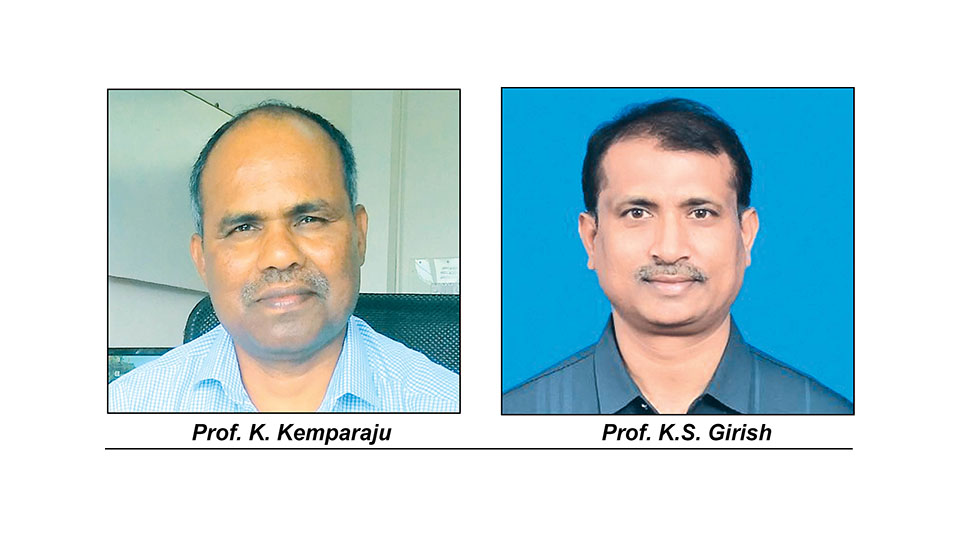
Prof. K. Kemparaju & Prof. Kesturu S. Girish to be honoured for Research Helping Humanity
Mysore/Mysuru: Prof. K. Kemparaju, Senior Professor, Department of Studies in Biochemistry, University of Mysore (UoM) and Prof. Kesturu S. Girish, Professor, Department of Studies in Biochemistry, Tumkur University, who have developed methods to save lives from Cobra bite and limbs from amputation by Viper bite, have been selected for Bhramara’s Prestigious Award for Research Helping Humanity.
Their determined effort, sound science and a spirit of innovation will save thousands of lives not only in India but in many countries of the world. Karnataka has the maximum number of deaths due to snake bite in India.
The award, instituted by the Bhramara Trust of Y.T. and Madhuri Thathachari, Mysuru, will be presented on Apr. 24 (Friday) at 5 pm at Sri Rajendra Auditorium, JSS College of Pharmacy, Sri Shivarathreeshwaranagar in city.
Sri Shivarathri Deshikendra Swamiji of Suttur Srikshethra and Chancellor of JSS Academy of Higher Education & Research, Mysuru, will grace the occasion and give the benediction.
Yaduveer Krishnadatta Chamaraja Wadiyar, Mysuru-Kodagu MP, will preside.
Padma Shri Prof. K. Vijayraghavan, former Principal Scientific Adviser to the Government of India, will be the chief guest. Prof. P.N. Rangarajan, ASTRA Professor and J.C. Bose National Fellow, Department of Biochemistry, Indian Institute of Science, will be the guest of honour.
Snake bites: A serious global health problem
Venomous snake bites are a serious global health problem, causing an estimated 81,000 to 1,38,000 deaths each year. Strikingly, India is the worst-affected.
According to an ICMR task force, around 58,000 people die annually in India alone, thus accounting for nearly 40% of the global burden that is about 160 deaths each day. Unfortunately, the breadwinners of poor farming families settled in deep pockets and rural, remote places are the worst affected.
In addition to deaths, snake bites leave many survivors with severe, harmful complications. Most snake bite cases in India are caused by four species: Cobra, Krait, Russell’s Viper and Saw-scaled Viper, collectively known as the “Big Four.”
Treatment
The only available treatment is polyvalent antivenin therapy (Antibodies raised against the venoms of the Big Four snakes), which can save lives if treated in time. However, currently, no therapy is available to prevent or treat the ongoing tissue damage caused, especially by Viper bites at the site of the bite.
Prof. Kemparaju, Prof. Girish and their group work extensively on venom pharmacodynamics, with a focus on its effects on immune cells, thrombosis and hemostasis, extracellular matrix biology and platelet biology.
Their research areas include understanding the mechanisms underlying Viper bite-induced sustained tissue damage, venom-induced oxidative stress and hypoxia and strategies for venom neutralisation using anti-venoms and small molecules.
Their group also investigates venom variability arising from the geographic distribution of snake species and characterises bioactive molecules with therapeutic potential.
In platelet biology, their work emphasises understanding the crosstalk between pathways that regulate platelet death and survival under various clinical conditions, with particular attention to heme-mediated signalling events.
Prof. Kemparaju, Prof. Girish and their group have made many landmark discoveries in snake venom pharmacology and these are published in various top-tier journals.
Recent Comments