


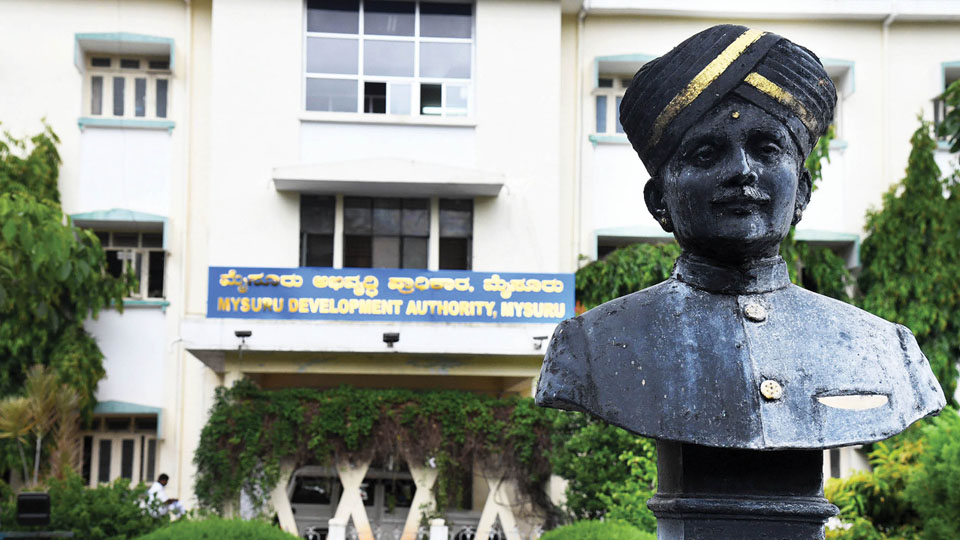
From CITB legacy to MUDA scams: Can the new MDA restore public Trust?
By R. Raghu (Kautilya)
[Translated from Kannada into English by Star of Mysore News Editor B.C. Thimmaiah]
There’s an old saying: “Closing the fortress gates after the town has been looted.” In the case of Mysuru Urban Development Authority (MUDA), this adage has a twist — loot first, then change the name — which is precisely what many believe has happened.
MUDA was at the centre of one of Karnataka’s biggest land scams. Allegations reached the doorstep of Chief Minister Siddaramaiah’s family and legal battles are underway.
Now, MUDA has been renamed Mysuru Development Authority (MDA), with a new framework and set of regulations. But had this transformation occurred earlier, perhaps this institution, founded on the foresight of Rajarshi Nalwadi Krishnaraja Wadiyar, might not have fallen prey to land sharks.
For decades, MUDA kept the genuinely homeless at arm’s length, denying them access to housing — a failure rooted in poor vision and commitment from those in power.
Nalwadi had envisioned a Mysuru where every family, as per its financial means, could own a house. As a testament to this vision, Nalwadi established the City Improvement Trust Board (CITB) in Bengaluru and Mysuru to ensure well-planned housing layouts for future generations.
Under CITB and the then Mysuru Municipal Councils, neighbourhoods like Chamundipuram, Vidyaranyapuram, Lakshmipuram, Saraswathipuram, Yadavagiri, Gokulam, Indiranagar, N.R. Mohalla, Siddarthanagar and Kuvempunagar were developed with essential infrastructure and long-term planning.
Mysureans still remember the selfless services of CITB Chairmen, including D. Seetharam Rao, M. Kantharaj Urs, A. Subramanya Iyer, B.G. Lakshman Babu, B. Subbarao, C. Sreekanteshwara Iyer, K. Mailer Rao, N. Madhava Rao, C.S. Kuppaswamy Iyengar, T.G. Rama Iyer, Keshava Iyengar, M.A. Srinivasan, M. Navaneetham Naidu, B.S. Raghavendra Rao, R. Ramachandra Rao Bhombore, N.S. Hiranayya, Palahalli Seetharamaiah, T. Venkataramanaiah, P. Gopalashetty, S. Linganna, B. Narayanaswamy, H. Kempegowda, B.N. Kengegowda, D. Lingaiah, Dr. Siddaraju, B.K. Puttaiah, and lastly, former MLC D. Madegowda. Their contributions have left a lasting mark on the city’s development.
Ashamandira — a legacy to remember
Known as Mane Madegowda, D. Madegowda, who was the last CITB Chairman, helped small traders and pushcart vendors realise the dream of home ownership through Ashamandira Scheme, furthering Nalwadi’s vision. After his tenure, CITB evolved into MUDA in 1988. But the public-oriented initiatives of the past did not survive the transition. MUDA failed to uphold the same commitment to affordable housing, paving the way for Housing Co-operatives to fill the void.
Some structured layouts — like today’s Dattagalli (Kanakadasanagar) and the four Vijayanagar Stages — owe their planning to former MUDA Chairman late P. Govindaraju. He also proposed a housing scheme for the economically weaker sections, but his short tenure stalled its implementation.
In the years that followed, MUDA remained out of reach for the homeless. Housing Societies mushroomed and developers began shaping the city’s real estate. Private layouts rapidly replaced public ones and eventually, apartments became the only option for many.
Even those who paid a premium for sites struggle today — many layouts lack basic infrastructure. Parks exist only on paper, footpaths have vanished and roads are barely wider than alleyways.
The city’s unplanned, chaotic sprawl is a direct result of MUDA’s corrupt, visionless administration. With self-serving officials and political interference, Mysuru has earned the dubious distinction of hosting one of the State’s biggest land scams.
Influence of unseen hands
Like the proverbial fence eating the crop, two Commissioners and their accomplices bypassed rules and regulations to loot thousands of sites — sites that could’ve fulfilled the housing needs of long-waiting applicants. These actions were bolstered by powerful political backing.
Even now, citizens wonder which invisible hands are shielding these officials from even minimal consequences, like suspension. CM Siddaramaiah himself faces allegations regarding illegal allotment of 14 sites, against which legal proceedings are going on. The same forces that allegedly allotted him 14 sites were behind MUDA’s systematic plunder, emptying it with brazen impunity.
When land was acquired from farmers, former CM S. Bangarappa had insisted on granting at least one 30’x40′ site per acre acquired. Thanks to Govindaraju, the 1991 incentive sites scheme was introduced to ensure fair compensation to landowners. But corrupt MUDA Commissioners twisted the scheme for personal gain.
By misusing the 2009 Farmer Participatory Layout Scheme and its 2015 amendment, they forged documents, cited non-existent Board approvals and sanctioned nearly 10,000 illegal sites in high-value layouts — a daylight heist.
As this massive land scam captured both State and National attention, the Congress Government now claims it wants to rescue the institution. A new law has been drafted, passed in both Houses and approved by the Governor, formally establishing the MDA.
Governance and corruption
With the establishment of the MDA, the Administrative Board of the now-defunct MUDA has been dissolved. All former members — including MLAs, MLCs, MPs, Government appointees, and Municipal representatives — have automatically lost their positions in the Authority.
This shift in structure has sparked concern that the MDA may fall entirely into the hands of officials as happened during the last days of MUDA involving CM Siddaramaiah. Now only one MLA is slated to serve as a member. Critics fear that without adequate representation from elected representatives, it may be difficult to hold the Authority accountable or curb bureaucratic excesses. But, then, even when the elected representatives were in MUDA, the worst corruption and looting had happened. It is not surprising that some private layout developers have expressed discontent with the new system.
However, given the extent of the corruption under MUDA, many argue that a repeat of such large-scale misuse is unlikely under the MDA’s revised framework. To better understand what lies ahead, it’s important to ask: Can MDA deliver where MUDA failed?
Scepticism surrounding MDA is valid, but it must be weighed against the past. Those questioning the risk of bureaucratic corruption must also ask:
- Didn’t MUDA, despite being guided by elected representatives, become synonymous with some of the worst land scams?
- Why did these very representatives fail to introduce housing schemes for over a lakh homeless families waiting in vain for decades?
- When private layouts were approved without basic infrastructure, who sanctioned the plans and issued no-objection certificates, leaving thousands of site owners stranded?
- Who shielded officials who illegally allotted thousands of sites without Board or Government approval?
- Why MUDA failed to recover encroached land? Was the involvement of powerful individuals and land mafia so strong?
- Why was MUDA unable to develop even a single new layout in the last ten years?
These fundamental questions must be addressed by former MUDA leaders — both elected and appointed.
Governance structure of MDA
Though MUDA has been disbanded, the Government retains the Authority to appoint a non-official Chairman to the MDA, who may even be an MLA. The governing body will also include:
- Four non-official members (political or social representatives).
- Departmental and institutional officials with key administrative roles.
- Supervision from a designated Minister.
Given this continued political and administrative monitoring, the notion that MDA is purely an official-driven body does not hold.
Administrative and vigilance framework
MDA’s operational structure includes:
- An IAS Officer as Commissioner and a Senior KAS Officer as Secretary.
- Representation from relevant Government Departments.
- A dedicated Vigilance Unit on the lines of Bangalore Development Authority (BDA), headed by a Superintendent of Police (SP). The team will include two Dy.SPs, Inspectors and other Police personnel.
- This Vigilance Unit will:
- Crack down on encroachments on MDA properties.
- Identify overlooked or deliberately hidden assets.
- Initiate criminal proceedings against offenders involved in property fraud or unlawful disputes.
Legal monitoring mechanism
To strengthen regulatory compliance, a Legal Cell will be constituted, headed by a retired District Judge and supported by two Assistant Judges. The Cell will:
- Scrutinise ambiguous approvals and decisions.
- Provide legal opinions on governance matters.
- Ensure all MDA decisions are legally sound before implementation.
Such mechanisms it is hoped will make the kind of unchecked looting, witnessed under MUDA, nearly impossible under MDA’s new regime.
One of MDA’s key promises is the digitisation of all records through a dedicated IT Cell. Each document will be tracked at every stage of approval, ensuring transparency and eliminating the possibility of files going “missing” — a notorious issue during MUDA’s tenure.
Public hopes and the road ahead for MDA
With the formal dissolution of MUDA, citizens now look to the MDA with renewed hope. There is an expectation that the new regulatory framework will usher in a more efficient, transparent and citizen-focused era — free from nepotism, corruption and political interference that plagued its predecessor.
Most importantly, lakhs of long-waiting applicants hope MDA will finally launch time-bound, structured housing schemes, addressing the decades-old demand for residential sites and homes. For many Mysureans, owning a house has remained a distant dream, despite years of promises.
If MDA can emulate the foresight and efficiency once demonstrated by the CITB, founded on Nalwadi Krishnaraja Wadiyar’s vision of inclusive development — it could effectively tackle urban challenges, including the persistent shortage of land for housing. Only then will the MDA’s creation be seen as a meaningful reform and not merely a rebranding exercise.
But should MDA fail to meet expectations, citizens may soon dismiss it as “old wine in a new bottle” — a reminder that systems don’t change merely by altering names.
Editor’s Note: A legacy to reclaim
The CITB remains a golden chapter in Mysuru’s urban development history — a model of public service driven by integrity, vision and a deep commitment to citizen welfare. Its legacy is etched into the city’s fabric, where every thoughtfully planned layout was once a symbol of governance with a human touch.
That legacy began to erode with the transition from CITB to MUDA. Over time, values that once guided development gave way to opaque dealings, political manipulation and entrenched corruption. The dream of planned, people-first development was steadily replaced by backroom deals and cronyism.
MUDA, instead of addressing the growing housing needs of thousands who had invested their savings in hopes of a site, became an enabler of private real estate profiteering. It presided over an era where vast public assets were diverted into the hands of a select few, deepening distrust and alienation among the very people it was meant to serve.
Now, with MDA taking the reins, Mysuru finds itself at a defining moment. Will this new Authority be bold enough to break from the past, restore transparency and prioritise the public good over private interest by forming new layouts and building houses for different financial groups, as under CITB?
Will it reclaim the ideals once championed by Nalwadi Krishnaraja Wadiyar and institutionalised by the CITB? Or will it simply inherit and perpetuate MUDA’s discredited legacy under a new name — MDA? Only time will tell.
Recent Comments