


Mysuru: Plant viruses are responsible for a 10-30 percent reduction in agricultural yields across the country, said Dr. H.S. Savithri, retired Professor, Department of Biochemistry, Indian Institute of Science (IISc), Bengaluru.
She was speaking at the inauguration of CSIR-CFTRI Platinum
Jubilee Lecture Series 2024-25 and the National Symposium on ‘Plant Protein: Structure-Function, Human Nutrition and Technological Advances’ organised by Council of Scientific & Industrial Research (CSIR)-Central Food Technological Research Institute (CFTRI) at Cheluvamba Hall on Friday.
Dr. Savithri highlighted the urgent need to develop permanent solutions to address plant virus-related crop losses. “The country faces an annual loss of about 15 billion dollars due to plant viruses, with bananas, paddy and tomatoes among the worst affected. Banana viruses alone caused losses worth Rs. 350 crore between 2007 and 2010, while paddy crop losses are estimated at around 1 billion dollars annually,” she noted.
Rising food demand by 2030
Former CFTRI Director Dr. V. Prakash drew attention to the escalating food demand projected for 2030. “The global requirement will touch five billion tonnes by 2030. Meeting this demand through a single production system is impossible; we need multiple food production units. With changing lifestyles and the rising popularity of ready-to-eat foods, technology and research will play a decisive role in addressing these challenges,” he said.
He also traced CFTRI’s legacy — from developing infant foods to instant meals and diabetic-friendly RTEs — and highlighted innovations in plant proteins such as Miltone, Suruchi Meetha, Mysore Atta and various weaning formulations.
Dr. J. Viswajanani Sattigeri, Head of CSIR-Traditional Knowledge Digital Library (TKDL), New Delhi, spoke on India’s traditional food systems, referencing classical culinary texts and the scientific insights embedded in Ayurveda-based dietary practices.
Dr. Sridevi Annapurna Singh, Director of CFTRI, Dr. Nandini Shetty, Head of the Department of Planning, Monitoring and Coordination, CFTRI and several other dignitaries were present.
Protein Plus Slice launched
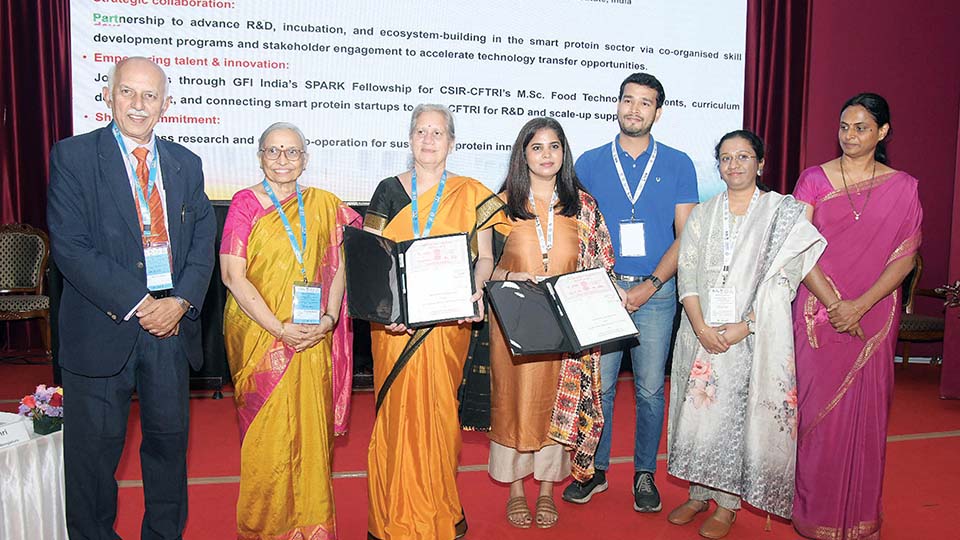
On this occasion, CSIR-CFTRI signed a Memorandum of Understanding (UoM) with Good Food Institute (GFI) India, marking a significant step in collaborative research and development.
Earlier, in collaboration with McDonald’s, CFTRI launched the innovative Protein Plus Slice in the presence of Yogesh Kadam, Minister of State for Food and Drug Administration, Government of Maharashtra, and Akshay Jatia, CEO of Westlife. The launch underscores CFTRI’s focus on impactful innovation with strong industry relevance.
The collaboration between CSIR-CFTRI, SYMEGA and McDonald’s R&D team has prioritised key attributes: High protein content, improved moisture retention to avoid sogginess or dryness, thin and flexible slices for better layering and enhanced flavour profiles such as umami and smokiness.
Additional goals include improved digestibility, balanced fibre and fatty acid content, microbiological safety and consistent texture and appearance.



Recent Comments