


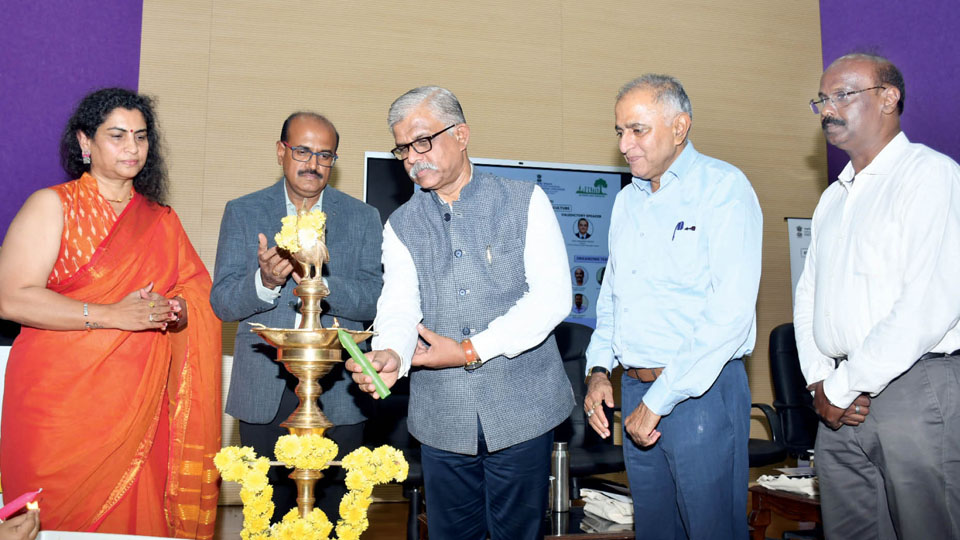
Mysore/Mysuru: A three-day national workshop on ‘Ethnography and Documentation of Culture’ commenced yesterday at the Central Institute of Indian Languages (CIIL), Mysuru, bringing together scholars, researchers and cultural practitioners from across the country.
The workshop, scheduled from Apr. 12 to 14, is jointly organised by the Indira Gandhi Rashtriya Manav Sangrahalaya (IGRMS), Anthropos India Foundation (AIF) and CIIL, with the objective of strengthening ethnographic research and documentation practices.
The inaugural session, held yesterday, set the tone for the intensive academic engagement planned over the next three days. Prof. Sunita Reddy, Professor at the Centre of Social Medicine and Community Health (CSMCH), School of Social Sciences (SSS), Jawaharlal Nehru University (JNU), New Delhi, delivered the welcome address.
She highlighted the importance of ethnography as an immersive, field-based research method that captures lived realities beyond theoretical constructs. She emphasised the need for authentic documentation of India’s diverse cultural traditions and encouraged participants to actively engage in fieldwork-based learning.
Introducing the workshop, Prof. Amitabh Pande, Director of IGRMS, Bhopal, outlined its objectives and stressed the importance of practical application in
research. He underscored the need for continuous learning, unlearning and relearning in ethnographic practice, noting that the programme adopts an interactive, participant-driven approach to foster critical thinking and collaborative learning.
Delivering the inaugural address, chief guest Prof. M.R. Gangadhar, Vice-Chancellor of Chamarajanagar University, underscored the urgency of preserving both tangible and intangible cultural heritage in a rapidly globalising world.
He remarked that culture forms the essence of human identity and emphasised that ethnography is not merely a research tool but a means of understanding communities through empathy and engagement. He cautioned that modernisation and digitalisation pose challenges to traditional knowledge systems, making systematic documentation a crucial responsibility. He also highlighted the role of technology, including audio-visual tools and digital archives, while stressing that technological interventions must complement human insight.
The guest of honour A. Devaraju, Commissioner, Department of Archaeology, Museums and Heritage, Mysuru, emphasised the importance of scientific and authentic documentation. He noted that India has often relied on external narratives due to gaps in indigenous documentation practices. He also drew connections between archaeology and ethnography, highlighting how material remains such as monuments and artefacts contribute to understanding cultural histories.
The inaugural session concluded with a vote of thanks by Sukanya Guha Niyogi of IGRMS. The workshop is being coordinated by Prof. P.R. Dharmesh Fernandez, Deputy Director, CIIL.
The programme is expected to equip participants with critical skills in documentation, ethical research practices and interdisciplinary approaches, thereby contributing significantly to the preservation and understanding of India’s rich cultural heritage.
The workshop has attracted over 40 participants from diverse academic backgrounds, including Universities and research institutions across India. Distinguished resource persons such as Prof. Shalina Mehta, Prof. Tanka Bahadur Subba, Dr. Khirod Maharana and Steffy Larka will lead sessions covering key aspects of ethnographic research.
As per the schedule, Day-1 focused on foundational concepts, research methods, ethnographic writing and Participatory Rural Appraisal (PRA), Day-2 features a field visit to Rampura village associated with M. N. Srinivas’s seminal work The Remembered Village along with hands-on sessions on the use of Artificial Intelligence in qualitative research. Day-3 will emphasise data interpretation, research proposal writing, policy briefs and group presentations, culminating in a valedictory session between 5 pm and 6 pm.
Recent Comments