


Dr. Devdutt Pattanaik – Author, Speaker, Illustrator, Mythologist
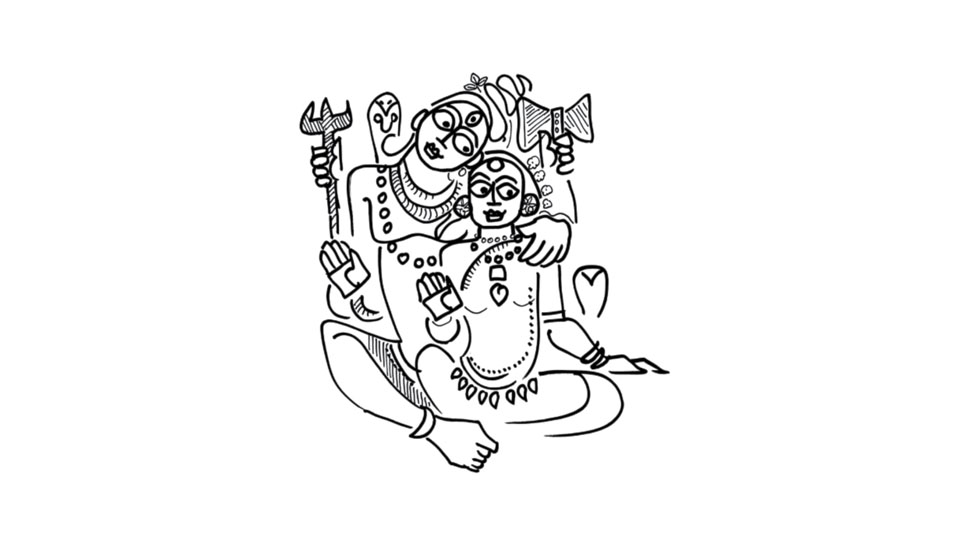
Shiva is described as an ascetic who is immortal and so, is not driven by any hunger or fear. He has no anxiety about death and no urgency to reproduce. He has no family line to continue, no ancestors whose debts he must repay, no estate that demands heirs. He owns nothing because he seeks nothing.
He is content and contentment frees him from the need to impress, accumulate or compete. This is why he can live on a snow-clad mountain of stone, smear his body with ash, knot his hair into matted locks, allow serpents to coil around his limbs and wander freely like a wild bull. Such a man does not need marriage. Why then would he marry and why would a woman choose him as a husband?
This question troubles Daksha Prajapati, the father of Vedic ritual order. For Daksha, society runs on participation, hierarchy and propriety. A man who refuses to engage with rituals, who rejects wealth and status, appears useless, even dangerous. Daksha cannot understand why his youngest daughter, Sati, insists on marrying Shiva. She walks away from her father’s house in defiance, not as a submissive daughter but as a woman who knows her own desire. The conflict is not merely personal; it is ideological. It pits ritual order against spiritual freedom, social duty against inner conviction.
Daksha retaliates by performing a grand ritual to which he invites all his daughters and sons-in-law except Shiva. Shiva remains indifferent. Worldly slights do not disturb him. Sati, however, is trapped between an uncaring husband and a cruel father. Enraged by her humiliation and by her father’s refusal to acknowledge her choice, she enters the sacrificial fire and offers her own body to her husband Shiva. This act shatters Shiva’s stillness. The ascetic who had conquered desire now encounters grief. In rage he destroys Daksha’s altar, the very foundation of ritual pride.
When the fury subsides, Shiva lifts Sati’s corpse and wanders the world. As he walks, her body falls apart, piece by piece, across the landscape. These places become the Shakti Peethas, sites where grief turns into sacred geography.
The story is layered in time. Early narratives from 100 AD only speak of the clash between Shiva and Daksha. The full Sati story appears around 500 AD and the idea of the body fragmenting across India emerges after 1000 AD. Myth here is not fixed history but evolving memory, shaped by the needs of different ages.
Yet the most significant part of the story begins after death. Sati is reborn as Parvati, daughter of the mountains. This time she approaches Shiva not with defiance but with patience, devotion and argument. She asks a profound question. If Shiva is content and complete, does he care about the discontent of the world? Does one who seeks nothing have any role to play for those who yearn, crave and suffer? What about ghosts who long for rebirth, souls who cannot find the path to immortality unless someone shows it to them?
Shiva understands the logic. Detachment may bring personal peace, but it offers no solace to a restless world. This time the goddess does not go to the god; the god comes to the goddess. Shiva agrees to descend into life and marry Parvati. Yet he has no idea how to be a groom. He has no family elders, no ritual knowledge, no sense of social performance.
He arrives smeared with ash instead of sandalwood, with snakes instead of garlands, with ghosts instead of relatives and riding a bull instead of a wedding horse. The wedding dissolves into chaos and laughter. Humour becomes a tool to soften fear, reminding society that difference need not be threatening.
After marriage, Parvati gently domesticates Shiva. She introduces him to the petty rivalries, quarrels and negotiations of household life. She does not destroy his ascetic nature; she gives it direction. As Annapurna, she cooks food for the world. Shiva, who never eats, becomes the distributor of that food. Together they observe how insecurity, envy and pride ruin human relationships.
The marriage of Shiva and Shakti is not about property, lineage or inheritance. It is not about power, spectacle or display. It is about two individuals giving meaning to each other. One brings stillness, the other brings movement. One brings freedom, the other brings responsibility. Together they discover a larger purpose.
Marriage, in this story, is not an economic contract or a social performance. It is a shared decision to engage with the world and make it meaningful, together.



Recent Comments